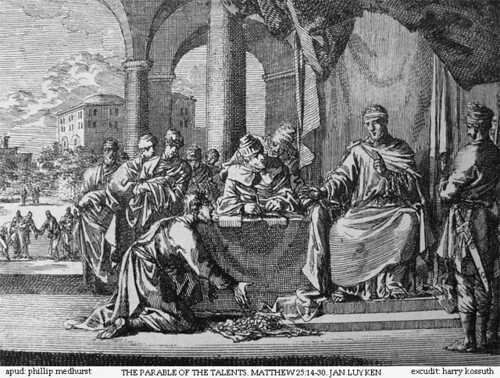
We continue with the idea of action and accountability in the face of the Last Four Things. Today, the parable shifts not towards the end of the world but rather fixes its focus on where we are. This is clearly brought up in St Paul’s Letter to the Thessalonians.
The Christian community was emblematic of an inability to hold the tension of being here in this world and yet being ready for the next. They were waiting rather anxiously for the 2nd Coming and yet complacency managed to set in. The thinking was that the “here and now” was not important since Christ would be coming already. They were wrong and St Paul exhorted them to labour while at the same time be ready for the Lord’s coming.
In the Gospel, the three players represent the spectrum which marks humanity. Two of them are truly engaged and they are commended for their stewardship. However, one of them chooses the path of safety and self-interest over courage in the face of risk and self-sacrifice.
It is true that we are on a journey. It is a pilgrimage with an end but the terminus is not necessarily in sight. This means that the journey is filled with choices to be made. Here, the logic of the Parable sounds rather commercial. God invests and He collects the interest. But if we think of the talents not as investments but rather from the perspective of collaboration and gifts, then the scenario will look different. We are put into the world not as if it were a salt mine, to work and pay back. Rather, we enter the world in order to enrich it. The question is how we can cooperate with God in this enterprise.
The measure of a talent is important. Different interpreters will give different values for them. According to one commentator, if we were to calculate value, a talent is worth an incredible amount of money. So, the man who was entrusted with one mere talent was actually given that much to begin with. The immensity of that amount suggests that “talents” are beyond the personal exhibition of one’s abilities as per BGT or AGT. It is much more than “personal” expressions or ownership.
Instead the parable is focused on the stewardship of God’s graces and gifts and our accountability for what we have been blessed with. When we view stewardship in terms of ownership, narrow selfishness can creep in. We might view stewardship as developing one’s gifts for self-improvement or to enrich oneself. Development in itself is not a bad thing. But when we take “blessings” as “ours” or “mine”, in general, we become afraid of losing what we have and the result is “possessiveness”. By and large, the world regards the blessings of gifts and talents to be personal possessions.
But what if we were to consider that everything we own is on loan, would we be more willing to share and sacrifice? The oft-quoted saying, “we do not inherit the earth from our ancestors, we borrow it from our children” expresses the truth of living on borrowed time and space. If we were not caught up with being entitled, then the idea of stewardship can flow into an attitude of taking care of things that do not belong to us.
Thus, the first two servants were freer in the “divestment” of the talents simply because they were caretakers of God’s gifts. In the end, they went out and got more. If we are able to accept that talents are not personal wealth but their goal is to benefit all, then we might not be “selfish” in guarding our possessions. Instead, while waiting for the 2nd Coming, we begin to see where our talents can be best utilised for the furthering of God’s Kingdom.
In this enterprise, noteworthy for consideration is the widening chasm between the poor and the rich. The pandemic has enlarged the pool of poorer people. And a minority has benefitted from the industries surrounding the prevention of infection. For example, glove and mask manufacturers, not to mention the pharmaceuticals. A simplistic solution would be to force the rich should share their wealth with the poor. After all, the Church has adopted the option for the poor which places the onus on the rich to be generous in divesting their wealth. This remedy is a bit naïve and possibly superficial because what is not obvious in the stewardship of wealth is the necessity of prayer. It is readily forgotten that wealth is also a spiritual reality. The more we have, the more prayers we need because the wealthier we are, the more tempted we are to vain-glory and pride. If a person has more money, he or she will be tempted to acquire a newer model of cars or a fancier dress. The list for consumption is endless because people with extra disposable income are urged through advertisements to indulge in luxury. Again luxury is not wrong in itself. We should not criminalise prosperity because it is meant to be enjoyed.
However, as Christ Himself pointed out, possession is more than a material reality. When the Rich Young Man came to Jesus to ask what more he could do to gain eternal life, he had to turn away because he was rich and was unable to part with his wealth as suggested by Jesus. The solution to bridging the gap between rich and poor has to be a spiritual undertaking because wealth is more than a material issue. It is a deeply spiritual challenge. We pray that in the spiritual struggle of those who are rich that they may be helped by the Lord against the sin of selfishness and be blessed with spiritual strength to use their good fortune for furthering God’s Kingdom. It is not easy to part with even what is not ours or what is on loan to us. All the more we need to pray not just for the poor but also those who have been endowed with more that they may come to recognise and accept the responsibility of true and humble stewardship.
It is a blessing to be given much by the Lord but it is a greater blessing when we freely render to Him what was His in the first place. The Parable of the Talents remind us that right stewardship of God’s blessing, used in accordance with His will, will have a significant impact on the world, especially for those whom God has placed in our care and this will become clearer when we read next week’s Gospel. Stay tuned.
Showing posts with label Parable of the Talents. Show all posts
Sunday, 19 November 2023
Sunday, 13 November 2011
33rd Sunday in Ordinary Time Year A
Last Sunday, I spoke of the internal disposition of a heart preparing for eternal life. This week, the Gospel illustrates, concretely through the parable of the talents, how this preparation may be lived out.With this in mind, I would like to approach the Gospel not so much from the perspective of how we can use the talents but to understand what our response should be when we draw the short straw—like the man who got only one talent. How do we deal with 1 talent?
Our consumer world markets a vision of life whereby the pot is always depicted as brimming and overflowing. In short, we deserve more than 1 talent. So if you do not have it all, you can attain it. It is a false vision of life where utopia is not really utopian at all. St Thomas More, in his book, Utopia described this island in the Atlantic that possesses the perfect socio-politico-legal system. The operative phrase is “an island somewhere in the Atlantic” denoting that it is not real or better put, it remains a goal always one step ahead. It would, therefore, be an illusion to believe that utopia is achievable here on earth. This is confirmed by the etymology of the word itself, which in Greek means “not the place”.
Nevertheless, our consumer world continues to push an idea that life must be nothing but pleasant and suffering must disappear. And by no means is this utopian vision restricted to the consumer world. In fact, every aspect of modern life is gripped by a philosophy that man has the right and duty to construct a new world based on a rational foundation. Take note that rationality here is understood narrowly to be governed by functionality, efficiency and also the quality of life. [1] Sometimes, you hear the phrase “new world order” bandied about; a kind of mantra for a reality no less than heaven itself. This new world believes that the rational application of technology makes possible a world in which suffering and inequality can be wiped out. It is quite mechanical and deterministic and this kind of thinking is reflected in arguments like “You should know it what” as if knowing necessarily equates to doing. We know that is not really the case. Some of the most brilliant minds in history have also been the most evil. But, we constantly run into difficulty on account of this mechanistic, deterministic and linear thinking.
Anyway, in this utopian new world order, possibility becomes the determining criterion for the measure of how life is supposed to be shaped. As long as our technology can achieve it, then it is permissible. In this so-called heaven on earth, what is possible has been coalesced into what is permissible meaning that morality now is defined as it is permissible for man to do anything he is capable of.2 Now you can appreciate why the Church finds it increasingly difficult to argue, for example, against the use of in vitro fertilisation. In vitro fertilisation is not a new technology. But, in any discussions on the morality of life issues, the Church will always be depicted as the voice out of touch with progress.
Now listen to what Pope Benedict said in his first encyclical, “When we consider the immensity of others' needs, we can be driven towards an ideology that would aim at doing what God's governance of the world apparently cannot: fully resolving every problem”. Here the Pope may be cautioning us against a utopian attempt to fill the gap where apparently God has failed. Our technological prowess is really an indictment against a God who has failed miserably. For example, childlessness is an indication that God has failed and the cure can be any method that best secures conception. Recently, there was the media hype that the world was marking the birth of its 7th billion inhabitant? It was presented against a backdrop of unprecedented hunger in the world and that mankind was taking a toll on the resources of the world. The unspoken assumption was that God could not have provided enough for the world never mind the fact that hunger could have been the result of uneven distribution rather than of inadequate resources. Have you noticed how people often drink water from bottles and leave them half-full? Not even water or wasteful?
So, has God failed? No. Perhaps a more realistic vision of the world is that we can never realise utopia on earth and that is not because life is unfair. Even the most perfect life you can ever conceive of will be imperfect or flawed. If we banish all hatred or fill every stomach yet we know that that is not enough. Instinctively you know this. Why? Because we all have a part of heaven in us. Here, I am not advocating that we canonise the status quo by resignation. For example, I am not saying that women should accept that their husbands abuse them or vice versa. Nor am I suggesting passivism in accepting the injustice of racial or religious discrimination.
Many young people entering adulthood are also ensnared by a utopian vision that everything good has to be achieved in their lifetime. No wonder life is so stressful. And they may be unwittingly forced to subscribe to what is possible must be permitted because that is the only way to achieve utopia (perfect life) here. The parable of the talents highlights firstly that short straws are an existential given. It is a fact of life that God’s providence does not work according to our sense fairness. Secondly, we will never be able to achieve all that we want here in this world.
Thus, utopia is restored to its rightful place. For Christians, it belongs in the realm of the Eschaton. It means that what we hope to achieve may sometimes come only in the next life. So, if our idea of utopia is confined to this world, then our response in time would probably be cynicism or despair. If we accept that the world will always consist more of short straws than full pots, then it does not matter what we have been given. It matters how we use what we have for what needs to be done. We no longer gripe as if we have been dealt an injustice. Instead we set about doing what we can with what we have instead of thinking of what we can do with what we do not have. For us to achieve that Christian utopia, we need keep our eyes focused on Christ our Lord and we work with every bit of our being to make things right but keeping in mind also that what we do may never be enough. Yet we are at peace because we know and trust that Christ, in the end, will make right what we cannot in this world and He will reward us with what we cannot have in this world.
In conclusion, I am hesitant to say this. I have this lump on my neck. How I wish it would go away but sometimes I do not want to do anything not because I am despairing. Here, I am not advocating that those with cancer should do nothing about chemotherapy or those needing surgery should not consent to it. Rather, I am informed by the Eschaton that beyond what is considered proper and necessary care, I do not need to have a perfect body to enter heaven. I need a healthy soul and therefore my effort is to run the race for which I have entered. What is important is not what I have been given what is important is how I use what I have been given.
FOOTNOTES:
[1] The quality of life argument is often used to justify euthanasia. Apart from that, it may be used also to justify eugenics, the science improving life even from the womb.
[2] The philosophy that says if you do not have it you can attain it thrives in this new morality where what is possible becomes permissible. The collapse of the wall between what is possible and what is permissible now renders any means as permitted as long as it helps the impossible becomes possible. As long as what is possible is permitted, then, technology can be co-opted by people who cheat and scam in a massive way. Since our life is premised on what can be done, then all manners of living should be respected. We call it “alternative lifestyle”. But life should be premised not only on “it can be done” but also on “should it be done”. This means we enter the territory of morality and this is where we will be accused of being judgemental if we do not subscribe to all possibilities available.
Labels:
Eschaton,
Ordinary Time,
Parable of the Talents,
Utopia,
Year A
Subscribe to:
Posts (Atom)