Showing posts with label Easter Vigil. Show all posts

Saturday, 4 April 2026

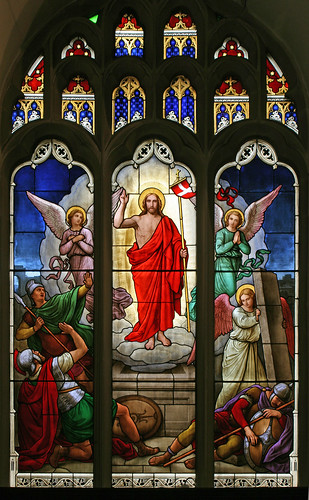
Easter Vigil 2026

This is a story told one time too many and I am rather shy to repeat it here. Abridged, it is about a boy named Sammy—a bit slow and dying from a disease. In his school the teacher wanted to illustrate the Resurrection and so gave each student a plastic egg-shell. Each child was told to put something into the egg-shell to symbolise the new life of the Resurrection.

One of them put in a flower representing new life. Another, a plastic butterfly symbolising a caterpillar transformation into a butterfly, another sign of new life. The teacher came to Sammy’s egg-shell. She opened it and it was empty. Not wanting to embarrass Sammy she proceeded to take another egg—shell. But Sammy shouted out… “Why are you not saying anything”? The teacher replied, “It is empty inside”. Sammy responded, “So too was Jesus’ tomb”.

He died and He rose and the only evidence we have is the empty tomb. But the empty sepulchre is not just a physical reality. For the Gospel of the 5th Sunday of Lent, we heard that Jesus raised Lazarus from the death. He bought him back to life but that revival was only an appetiser, a foretaste of what was to come. That was not the resurrection but a resuscitation.

More than a vacant tomb, the empty sepulchre is a powerful proclamation of Christ’s victory over sin and death. Death can no longer hold on to us for eternity. Instead, death now becomes a doorway, offering hope to us in a life which is often incomprehensible. For example, how is one to make sense for someone whose life is just one mishap after another? You know the kind where one bad thing happens after another. Or someone for some tragic reason, life is cut short just when one’s fortune is about to take off?

All the Readings, both old and new, and the Gospel provide a view that history, since the beginning of creation, is basically a testament to the Resurrection. Firstly, sin came into the world and the world, suffering the sting of eternal damnation, has been groaning for salvation. Christ has always been the awaited Saviour. Creation and humanity having always been longing for Him so that we may have life to the fullest.

The word “fullest” has different meanings for people. Amongst our generation, it is a promise buoyed or propped up by a material foundation. The Chinese “fuk1, luk6, sau6” (福, 祿, 壽. Cantonese pronunciation) best epitomises this materialism which reflects a preoccupation with prosperity, position and permanence (longevity). We conceive of a fuller life when we are materially or even psychologically fulfilled or contented. Even our information superhighway, now propelled by artificial intelligence, promises us a more complete or wholesome existence.

Yet, baptism numbers seem to have increased in some developed and progressive countries where there appear to be no need of religion. For example, France saw the highest number of baptism in the recent past. Why? In London, I encountered people attending mid-day Masses and people going for Confession. Why?

Perhaps fullest is ironically incomplete when it is based on a material satisfaction or even psychological gratification. Buy the “hot-off-the-press” whatever and you know what that means. The minute you possess the latest computer, phone, car, house, the item purchased is already obsolete. By September sometime this year, your cutting-edge iPhone 17 will be outmoded. And we are left craving for more which is nothing more than a pining for a permanence which is transcendent. The soul has a hunger for heaven which we have mistaken earthly realities for. The pathway to heaven can only be traversed through the Resurrection.

So Lazarus or anyone brought back to life had to die again so that they could experience the Resurrection. Christ conquered death to free us from the fear of dying and death. Death is no longer the final chapter that closes our lives in this world. The man or woman who in the eyes of the world is considered a failure now stands a chance of redemption and completion, if not temporally, then eternally. Christ by vanquishing death has made it into a pathway through which we could pass over safely. The Viaticum now makes a lot of sense. We gain spiritual strength from consuming Jesus so that we can make the necessary transition for this life to the next.

When the stock exchanges or financial markets were having it so good, materially that is, all it took was for the pandemic to uncover the false promises of economic prosperity. We were stopped in our tracks and the world woke up to the question, “Is there more?”. Right now, Iran may provide yet another chance for reflection. Iran's indiscriminate use of conventional weapons of war has put many on edge with questions. What if she truly possesses enriched uranium, enough and unafraid to to initiate a nuclear winter? The very fear of death which we encountered during the pandemic and now with Iran's nuclear capabilities, has now given courage to people to peer beyond the curtain of mortality imposed by existence to a more promising completion. Is there more that awaits after death?

That promising fulfilment is called the Resurrection. If Jesus did not rise from the dead, He can stay buried with Muhammad or Muhammad can even outrank Him. Jesus can sit with Buddha and converse on the cycle of endless reincarnations. Or Jesus can enter into the multiverse of the Hindu deities. But He rose from the dead, proving that He is the Lord of Life. Death and life are in His hands and because He holds life in His hands, we are empowered to live beyond the fear of dying. He alone can offer us a new life.

O death where is your sting and O grave, where is your victory?

The martyrs whom the world considered to have senselessly lost their lives are alive in Him because what was their annihilation was in fact their triumphant entry into the new life of Christ. Thus, every single saint who suffered in this world, or all who went to their death as if they were considered failure in this lifetime can take comfort that their death will not be the end. Tonight’s empty tomb affords us reason to live with hope because life to the fullest is promised by Risen Christ.

Saturday, 19 April 2025

Easter Vigil/Sunday Year C 2025

From Good Friday’s long Gospel narrative that should allow us to enter first-hand into the drama of Christ’s Passion, Easter Vigil takes us into another journey. Easter Vigil is where we grasp the full breath of the history of salvation. We began with creation, followed quickly by the Fall. But we heard, reading after reading, how despite our treachery God has kept close to us and He promised to save us. This covenant was sealed through the supreme sacrifice of His Son.

Both the Vigil and Sunday are celebrations of the Son’s victory. Through these three sacred days, we have come to appreciate that the price of sin is eternal death but we also acknowledge that Jesus, the Son of the Father, managed to conquer death. Not only has Jesus Christ saved us but He has also pledged the Eucharist, that is, the Sacrament of His Body and Blood, as the food and strength for the journey to eternity.

Let us rejoice because He has risen. As the Exultet commands, “Earth, shake off your lethargy”. Even if life were unfair and nothing seems to work for us, still we dare to enjoy because He has risen. If He had not, then our hope would be pointless and we would be condemned to an existence which is characterised by the “here and now”. Such a dreadful vision traps individuals in a miserable existence and since there is no Resurrection, we are doomed to live it up and are driven to extract as much as we can from this life. Without the Resurrection, we are lost and winning means being ahead of everyone. It is a kiasu (fear of missing out) and kiasi (fear of death) existence. [Have you ever felt so dissatisfied that you just need to have the last say or justify yourself because you have been misunderstood? Or you feel that only revenge can satisfy your rage. These are tell-tale signs of a life “condemned” to get the most of life].

This is why we need the assurance that Christ has truly Risen so that we do not need to fear losing out. How can we be sure? If we could, take some time to slow down and to contemplate the first place that He should go after Histriumphant resurrection. Sacred Scripture is mute in this respect but we can imagine the first person to whom He would appear—Mary, His Mother.

Visualise a woman who has pondered things in her heart. She does not have all the answers in the world and yet she may have had an instinct that Calvary was not the final chapter. It was just a matter of time and at the most unexpected moment, a powerful presence was felt. We know this because of His subsequent appearance to the 11, to the 500 and to Paul. He appeared when they least expected Him to. So, He came into Mary’s presence and the first words that greeted her were “I have conquered”.

An unrecorded scenario such as this is not alien to us. During those times when we are most lost and feel that God is absent, those are moments when He is most present. We will never lose out no matter how defeated we feel. Christ conquest over eternal death gives every soul hope and a chance at life eternal. Tonight, today, the behold the wood of the Cross on Friday has become Christ the Light. Thanks be to God that Sister Death has loosened her grip as the Crucified Christ rose victorious through the Resurrection.

It is an invitation to behold the empty tomb—a commanding image of death’s inability to hold onto us forever. Christ’s conquest over death not only gives us hope but more than that, the empty tomb is a symbol of Christ’s presence amongst the living. From utter and condemned sinners, we are now sinners who have been saved.

We remain hopeful for no matter what, we cannot be lost forever. But more than not being lost, the Resurrection belongs to Christ’s desire to shape creation according to His Sacred and Saving Heart. Coming as man, He identified with us but as God, He saved us and now invites us to be part of His mission. Baptised into this mission, we reshape the world by becoming His salt and His light.

What does that mean?

It is rather simple. We are not speaking here of ending racism or terrorism, solving world hunger or chronic poverty, reversing climate change or abolishing mass migration. These are righteous intentions. Right from the beginning and even before embarking and embracing these noble quests, we should become salt and light simply by expanding “human consideration”. How so? Our parking and our driving can be a good place to start. I am not criticising anyone who comes late for Mass, you have your reasons. However, a suggestion is to leave a bit earlier from home and that might help in avoiding bad driving and indiscriminate parking. If everyone here does it, imagine what sort of experience this Taman where we are planted would have of us who regularly jam up this place? The car-wash owner has repeatedly complained to me about some of us who park where they do business. And because they are Banglas, their request is shrugged off because they are supposedly less human than we are. What sort of messaging are we giving them?

The point is that the life of the Resurrection begins with me. Not with big projects out there. Modifying my behaviour will come a long way to affecting others. People are turned off not by Christ’s message but they are turned off by me, by me personally not living Christ’s message. No matter how great the message of the Resurrection, people will find its validation in the messengers.

We are the messengers of Christ and His Resurrection. Are we convincing to others? We are going to celebrate the Malaysian Pastoral Convention next year. It is a big event. What could be bigger is not the assembly in Majodi but rather here in the Cathedral. Can we have 50 baptisms next year? Is it logistically challenging? Yes. But it would be a fruit of our messaging and most of all, our witnessing. It would be great also to have more adults who had missed their Confirmation, coming to complete their initiation into the Church. Inviting couples adrift in the limbo of irregular unions who willingly come forward toseek regularisation of their marital status would be good progress. Finally, to welcome Catholics who have ventured away from the practice of the faith to return to their true and spiritual fold, the Church.

He is Risen, without a doubt. The empty tomb is proof and yet there is a disbelieving world that challenges us, His messengers, by asking where the fruits of Christ’s Resurrection are to be found. For that, we need to look into ourselves. As we exit the Cathedral later, ask this question. Am I ready to be His salt of the earth and His light of the world? Will the face of the Risen Christ greet those who encounter me?

Thursday, 28 March 2024

Easter Vigil/Sunday 2024

Cinematic thrillers capture our imagination because they skirt at the edge of excitement. How about visualising this dramatic movie scene? A man or a woman buried alive in a coffin. And the police and the loved ones are frantically trying to locate the trapped victim before the oxygen runs out for the buried person.

Hell is that buried coffin with souls trapped within. Souls held captive in hell’s bowels have no chance of escape until now. When Christ was brought down from the Cross on Good Friday and His Body ritually prepared to be entombed, we might think that He was laid in the sepulchre where lying there passively He awaits for the third day, His Resurrection. However, the Apostles’ Creed states that “He descended into the hell”. Tradition calls it the Harrowing of Hell and it refers to Christ descending into Hades to free souls trapped there from the beginning of time.

The idea that Christ entered into Hell makes a hell of a sense. Anyone born before the Resurrection of Christ does not stand any chance of going to heaven at all. They may have been righteous. People like Abraham, Sarah, Aaron, Miriam, Moses, Elijah, all the Patriarchs and Prophets of old and even Joseph the father of Jesus. They still need the grace of God which comes only through His Son, our Redeemer. This grace of redemption gives meaning to the dogma of the Immaculate Conception. Christ saved His mother at the moment of her conception precisely because every soul needs justification, either through Christ’s harrowing of hell OR Christ’s redemption won through His resurrection from the dead.

Just visualise Joseph, the father of Jesus, a man of honour, on Holy Saturday meeting His Christ as He descends step by step into hell to draw souls and allows them to be taken up into heaven. All righteous souls were not damned to hell but neither were they redeemed until Christ’s Resurrection.

During the hours after His death on the Cross, Jesus was not relaxing but was relentlessly busy with the mission of salvation. Take a look at the Catechism of the Catholic Church. Christ descent into hell was not an insignificant moment because the “Gospel was preached even to the dead” (1 Peter 4:6). In Hell, Christ “brings the Gospel message of salvation to  complete fulfilment. This is the last phase of Jesus’ messianic mission, a phase which is condensed in time but vast in its real significance: the spread of Christ’s redemptive work to all men of all times and all places, for all who are saved have been made sharers in the redemption” (CCC 634).

Tonight/today, the tomb stands empty. It is a sign of the Resurrection. Christ's bodily resurrection completes His victory over sin and perpetual death. The empty tomb stands as a symbol of our faith in the Resurrection. Faith begins with the senses but it does not end there. This faith in the Resurrection calls us to grow more and more comfortable with the reality of dying, of actual death but always in the light of rising to new life.

It is a life long journey and who better to represent us than Peter. He did not start as Peter the martyr. He started as one eager and later became a bit of a show off and when faced with difficulties, failed the Lord catastrophically by denying Him. Now all Peter sees is the empty tomb and he believes. This coward will soon gain the conviction to even die for the Lord. In Peter we have hope that our weakness may through the grace of Christ’s Resurrection be converted into conviction that courageously holds onto Christ until the end.

The truth of the Resurrection is found in the Harrowing of Hell and it teaches us that Christ died and rose from the dead that we might have a firm faith to know deeply that death cannot hold on to us forever. Our old and unredeemed history ends with the Cross. Our new and redeemed history begins with the Resurrection. Alleluia, let us rejoice for Jesus Christ is Risen.

Saturday, 16 April 2022

Easter Vigil 2022

We have travelled with Jesus during the entire period of Lent and now we stand at the cusp of the Resurrection. On Holy Thursday, we acknowledged His humble service as He stooped and bent low to wash the feet of His Disciples, after which, He gave them and bequeathed us His Body and Blood as food and drink. Yesterday we watched helplessly, painfully aware that His Body, battered and bruised, hanging on the Cross, bore the brunt and burden on our iniquities even as precious life drained out of Him. Last night He was laid in the tomb to await the 3rd Day.

Just like Good Friday, we theoretically do not have a Mass today. Traditionally, the Vigil was celebrated as late as possible in the evening which makes it more a Midnight Mass of Easter. The service is supposed to stretched until dawn breaks. For this reason of Mass celebrated very late at night that today is called Black Saturday in some places which means that it remains a day of prayer and penance.

There are two ways of looking at Holy Saturday. According to some customs, the Body of Jesus is still in the tomb. Penance, apart from prayer and fasting, expresses itself in silence and stillness because the King is asleep. We accompany Him. This is according to an anonymous 2nd century sermon. On the other hand, the tomb could be empty but not because He has “risen”. Instead, He is busy as the Apostles’ Creed states that “He descended into hell”. There are two categories of souls in Hell—evil or righteous. Christ entry into Hades was not to deliver the damned nor to destroy the hell of damnation. Instead He went there because the righteous and holy souls are waiting eagerly for His deliverance—like Lazarus in the bosom of Abraham. The same ancient anonymous sermon tells us that in descending into Hell, Jesus told the righteous souls, “My sleep will release you from the sleep of Hades”. Even in death, the Saviour was hard at work rescuing souls who had been expecting Him.

As we cross midnight, this Vigil carries us into the 3rd day. As after the Sabbath, the ladies who were concerned to embalm Him went to the sepulchre where they encountered an empty tomb and two angels who asked them, “Why look among the dead for someone who is alive? He is not here; He has risen”. The description of the “3rd day” is a powerful resurrection motif because the 2nd Adam, Jesus Christ rising from the dead has renewed creation. As humanity is recreated, we encounter two powerful symbols at work. Firstly, we have the fire that becomes light. Secondly, there is the water of regeneration. Both are associated with the Rite which will take place shortly after this: Baptism.

This Rite celebrates Christ’s victory over sin and death. We hear the word “victory” but we may struggle to understand “sin” and “death”. Bear with me. Gathered tonight are a select few. These Elect will be baptised. Water to wash away Original Sin and whatever sins they may have committed since birth. Light to illuminate the path that starting from now they will journey on.

The presence of these Elect helps us to appreciate what we are doing here and what we are to become. Christ’ victory over sin and death is the “raison d'être” or the basis of Mother Church’s evangelical mission. Sadly, we tend to associate this task with preaching the Gospel, that is, to go out and proselytise. That is not the full story because Jesus descending into Hell provides a more complete picture of the Church’s vocation—to preach the Gospel and to save souls. The Church is in the business of proselytisation and salvation. In other words, preaching the Gospel is one thing, souls can be lost which makes salvation really an urgent matter to think about.

The Elect are baptised in order to be saved. Otherwise, baptism does not make sense at all. When we declare Christ’s triumph over sin and death, immediately we realise that we are not here just to “hear” the good news but also to appreciate that at the heart of salvation is the struggle for souls. From Palm Sunday till this moment, we went through the Paschal Mystery following Christ who submitted Himself to death in order to ransom sinners, one and all.

Otherwise, why be saved if we have no sin? Everyone here is a sinner who needs salvation, baptised or not.

The Church is not a spa. She was not founded to molly-coddle us, to meet our preferences or even our tastes. She is the prime battleground for souls. It is understandable that we demand “safe-spaces” and the Church should be a place where people feel safe and secure. But I am not referring to that kind of safety or security. Sadly, we may have been swept by the current culture of comfort and convenience that we are entitled to feel good when coming to Church. True, the Church is a sanctuary for souls because as a Mystery and Sacrament she is holy and therefore a sanctuary. But as a human institution, populated by sinners, she is not immune to the forces of evil because it is the nature of evil to battle for souls where they least expect it. Just because the Church is holy does not mean that the Satan will leave her alone. Indeed, Satan does not have to win over the souls who are damned. They already belong to him. Ever since the beginning of creation, he prowls about looking for souls to devour and how would Satan win if not by bringing down the Church in her sons and daughters?

This is definitely not a message that you would want to hear this evening or this morning. The truth is that every baptism we attend is our wake-up call. The Cathedral has only 6 baptisms this year. You can use the excuse of the pandemic for this poor showing. But is this the Mother Church of the Diocese of Malacca Johore? The dismal number may shamefully uncover the quality or the lack of in our discipleship. This is not a number game but what it exposes is perhaps the Gospel is not that great to attract attention. We know that it cannot be so because the Gospel is powerful—God’s word does not go out without achieving its purpose. What the depressing number of baptism indicates is how unappealing we are. We are pathetic witnesses.

But feeble witnessing aside, perhaps we are not “sinful” enough to appreciate our salvation. This is not an invitation to commit more sins. Rather we need to plumb the depth of our waywardness to grasp the scope and span of hell that Jesus would scour to save our souls. A grateful heart draws attention not to itself but to the One from whom one has received much. You observe this phenomenon in those who serve devotedly. They are not in the service for the name but because they have been saved by Him and therefore their witnessing is a return of love for love. Tonight, we are joyful because Christ’s salvation has reached the hearts of our Elect. We ask that through the renewal of our baptismal vows, the flame in our hearts may be rekindled so that grateful for our salvation, we shine brighter to attract into the fold those who are searching for Christ and for His salvation.

Sunday, 5 May 2019

Easter Vigil 2019

A theme central of Easter is creation. For Christianity, creation is “creatio ex nihilo”—that is, God created out of nothing. Many of the pre-Christian religions hold the idea that God and creation are identical. That is pantheism. If not, God must have created the world out of existing matter which He Himself did not create. Like a sculptor carving out a statue, God must have found a slab of marble and carve out of it, the universe.

The first reading presents the panorama of creation spread over a span of six days. On the seventh day, God’s rest became the basis for the Jewish Sabbath.

Tonight we are also celebrating creation but this is not creation ex nihilo. Instead this is recreation or creation anew. Not long after God shaped the universe, sin entered the human condition. This was not premeditated as if sin was intended to be but it was not unexpected either. Why not unexpected? Short answer: Freedom. To be truly free, it must include the possibility of rebellion against the God who created us.

Thus, the readings that followed after, summarises the long history of man’s betrayal which culminated with God’s ultimate act of faithfulness. He did not spare His Son but gave Him up to ransom Adam’s debt. Through Adam, man has become death. Through Jesus Christ, death lost its eternal grip over us. Death has been overpowered by the Resurrection of Jesus Christ.

As the Exultet reminds us, “O felix culpa, O happy fault, O necessary sin of Adam that gained for us so great a Redeemer”. This happy fault brings us to what we are doing now at the Vigil as we enter into Sunday.

In the old schema of things, God rested on the seventh day—the Sabbath. Christians, however worship God on Sunday. According to the Catechism of the Catholic Church, ”The Church celebrates the day of Christ's Resurrection on the "eighth day," Sunday, which is rightly called the Lord's Day” (CCC2191) Sunday is our Dies Domini (the Lord’s Day) which happens to be Dies Christi(Day of Christ) for our Creed professes that Christ rose on the Third Day. It is the day of creation’s rebirth inaugurated by the Resurrection of Christ. In turn, it becomes the Day of the Church, the Dies Ecclesiae for the Holy Spirit descended upon the Apostles on Pentecost.

Sunday is truly a day of the new creation of grace. And understandably, we have our elect baptised for soon they will be recreated new by water and the Spirit. The message of the Epistle before the Gospel is important because it describes what it means for us to be this new creation in Christ: We must realise that our former selves have been crucified to destroy this sinful body and to free us from the slavery of sin.

Since, we have been purchased by Christ to live a new life, Sunday is therefore an important day for us. 49 Christians died in the year AD304. The record of their trial is still extant. They disobeyed Emperor Diocletian’s edict and when asked by the Proconsul why they had defied Imperial prohibition, the answer given was: “Sine dominico non possumus”,that is, without Sunday we cannot live. If we do not join together on Sunday to celebrate the Eucharist, we would lack the strength to face our daily problems and not to succumb. Sunday is life for them and they would rather die than be deprived of it.

Sunday is not merely a day of obligation. It is truly a Dies Homini, the day of man given so that we may remember the Creator through our rest and recreation. The problem we arises when we reduce Sunday to a day of obligation. Any obligation, when it is forced upon us, “weakens” our autonomy. Nobody likes his or her faculty of choosing to be curtailed. But, this obligation is not an imposition as it is a protection of a value. It is not just any day but the Day of the Lord. Worship rises up from the depth of who we are—created anew in Christ Jesus, we give Him our time—to be fair, His time actually—to be sanctified by His presence—through the Eucharist. (BTW, every second we have is borrowed time).

If I were to say something rude, like a four letter word, many will be disturbed and feel that it should not be uttered in Church. Instuitively, we know that there are boundaries. This is inbuilt into us, for inherent in our nature is a sacrality with regard to time and space. We acknowledge this sacredness when we wish someone on his or her birthday itself or celebrate it on the day rather than any other day.  It does not make sense for me to wish you “Happy Birthday” when it is in December. This sacrality of time is exhibited in the Church’s preference for Mass on Sunday.

What is so important that we attend Mass on Sunday? For example, in the matter of rest, if Sunday’s holiness is kept by resting, what if my rest-day is on a Tuesday? It is a rest day after all. However, the assumption is that everyday is the same as long as it is a rest day. True? Thinking along the same logic, every surface is the same as long as it is a surface. So, if you use a bowl to drink soup, why not a toilet bowl, after all both are bowls? The very suggestion to lick and lap your soup from the toilet bowl is abhorrent and it proves the point of sacrality in both time and space.

This evening, the Church is packed and those who find no place inside here are seated in St James’ Hall or St Paul’s Room. I mentioned last Sunday that the Church should be packed like this every Sunday. The truth is, we will return to “normalcy”—a Church barely full. Why? Perhaps we have failed to appreciate the newness of who we are brought about by our baptism.

Some of us come because Catholics have this homing device to come twice a year—Easter and Christmas. Perhaps, the newness of creation is not enough to keep them coming every Sunday. Or, simply no time for God. Life is stressful and God is a hassle—so let the weekend be a holiday elsewhere. Or maybe, just maybe, a deep sense of unworthiness before God? Keeping away on Sunday because of this sense of failure before God is just one way of telling God, “Hey, you are not worthy of me”.

If we give God the time that belongs to Him, we will definitely be transformed because He is the Lord of time. To paraphrase Benedict XVI, “Return Sunday its soul by giving the soul its Sunday”. We need Sunday for our sanity, sanctity and salvation. As St John Paul II reminded us, “Time given to Christ is never time lost, but is rather time gained, so that our relationships and indeed our whole life may become more profoundly human”.

Sunday, 24 April 2011

Easter Vigil Year A

Recently, an animation movie hopped into town, with a character named EB voiced by “l’enfant terrible” of the British entertainment scene—Russell Brand. He resigned from BBC after a scandal which involved leaving an obscene voice message on air during a phone-in session. This is just the side-salacious dish. What is more important is EB the character. Who is he and does he have anything to do with what we are doing tonight? From the looks of it. Nada. Nothing. First of all, EB actually stands for Easter Bunny and the premise of the movie centres around EB assuming adult responsibility of distributing Easter Eggs on the one day that matters most: Easter. In the movie, if at all any connexion can be made, the animation seems to show a total discontinuity with Easter by secularising what Easter is all about. They have this important deadline to meet with absolutely no connexion to why there is one in the first place. All we know is that there are billions of eggs to be distributed.

Present-day Easter Bunny has obscured the central message of what Easter is really about. Whilst Easter Bunny cannot be further away from Easter, the Easter Egg actually is strong symbol to what we are doing tonight. How? Let me tell you a story I read once about and it concerned a retarded [1] child named Stephen.

His Sunday school teacher wanted to illustrate the meaning of the resurrection and new life. So she gave them each an empty plastic egg shell and ask them to put an object into the empty shell to represent new life. One child had a tiny flower in it. “A lovely sign of new life," said the teacher. Next came a rock which the teacher thought could have been Stephen’s. But, its real owner shouted: “Moss! Moss on the rock symbolises new life”. The teacher had to agree. Then what followed was a butterfly and the child was quite sure that hers was the best. The fourth was empty and this time the teacher was quite sure that it should be Stephen’s. Politely, she passed it, to reach for the next plastic eggshell. Stephen spoke up: “Please! Teacher do not skip mine”. “But, it is empty”, said the teacher gently as not to “hurt” Stephen’s feelings. "That's right," said Stephen, "The tomb was empty, and that represents new life for everyone."

The story continues with Stephen dying on account of his deteriorating retardation. But, the profound insight we learn from such a written-off soul is what the Resurrection really means. The Resurrection’s most powerful symbol is the empty tomb. Contrast it with how we always want to fill up whatever is empty. I have this Easter Egg left outside my door by the Easter Bunny. It is filled with a heart-shaped chocolate piece. Most of our commercial Easter eggs seem to have missed the point.

My dear neophytes-to-be. You who will be baptised are signing up for this: the empty tomb whose emptiness symbolises the eternal life which Christ has won for you. St Augustine’s famous prayer about “restlessness” is helpful to understand what the empty tomb means. “O God, my heart is restless until it rests in you”. This restlessness is probably the equivalence of the empty tomb. There is a emptiness which can never be filled with things of this world. Try as we may, things of this world will only crowd our hearts but never will our hearts be at peace. Instead, things of this world can only weigh us down. No matter how much we try, we cannot belong to this world. Instead, that emptiness is symbolised by a restless heart longing for God. We may be in this world but we do not belong to this world.

Christianity is the Resurrection and no less. There is a difference between a resuscitation and a resurrection. Lazarus was resuscitated. It was miraculous but not really out of this world because he would die again. The resurrection is like a resuscitation and yet totally unlike it. According to Benedict XVI, and note that he uses the language scientists would go gaga about, “the Resurrection is the greatest 'mutation', absolutely the most crucial leap into a totally new dimension that there has ever been in the long history of life”. In the case of a resuscitation it might just be a newsworthy anomaly but this, the resurrection concerns us and the whole history of mankind. Through faith and baptism we become a part of this history.

So brothers and sisters, through baptism and a life lived in faith, death will never be able to hold on to us forever. The possibility of the Resurrection means according to St Paul, “It is no longer I who live, but Christ who lives in me”[Gal 2:20]. And this is the implication of the Resurrection, it is not only now but for eternity
FOOTNOTE:
[1] Politically incorrect. Special is the preferred term. But, what is so special about special when the result remains being marginalised.

Saturday, 3 April 2010

Easter Vigil Year C

I wish tonight could go on forever. You heard me right. A service of 2 or even 3 hours is just too short. But, the reality is that, like all Catholic services, one always keeps an eye on the clock. It is almost barmy to wish for a long service because people will grow restless. Perhaps “restlessness” is the key to understanding why tonight should be a long service. We celebrate the most solemn of Christian feasts. The larger than usual crowd is testimony that we instinctively know this to be so—that this is a solemnity like no other solemnity and that we have to be here somehow. Why?

The reason is a celebration that is out of this world—the resurrection. The gathering of the Elect is tied to the hope of the resurrection. In the Letter of St Paul to the Romans, we discern the strong connexion between baptism and the resurrection. “When we were baptised in Christ Jesus we were baptised in His death; in other words, when we were baptised we went into the tomb with Him and joined Him in death, so that as Christ was raised from the dead by the Father’s glory, we too might live a new life”. The basis for baptism is so that we can enjoy the resurrection.

The central proclamation of the Church is the hope of the resurrection. In the Acts of the Apostles, truly a class act, Peter’s preaching or kerygma forms the basis of the apostolic teaching that has come down to us—a kerygma that witnessed to the life, death and resurrection of Christ.

So, how can we appreciate the resurrection 2000 years later? Imagine the 3000-strong Pentecost crowd and as the Acts says, “they were cut to their hearts”. But that is not the end of the story because they asked Peter and the apostles what they must do; just like the Elect asking for baptism. I can imagine how it must have felt like to be there to hear the Apostles’ testimony of their experience of the resurrection of the Lord. The Apostles ate, joked, talked, walked, roughed it out in the open, and finally, after the resurrection, they touched the wounds on His hands and side.

In a sense, they were truly a privileged lot. Would it not be nice to be where they were? It would make what we have here pale in comparison. One almost wishes to be where they were and surely faith would be much easier.

But, is that true? This is plain wishful thinking, just like what we often hear people say: Seeing is believing; seeing makes believing easier. If only we were there, would not faith be easier? In a sense, it might be but being there is no guarantee of faith. If Jesus were to appear today, many of us would have difficulty believing Him to be He. Why? You see, in the matter of belief, probably there are broadly two categories of people. First, the gullible people we read about in the newspapers. For example, the people who believe that paper can turn into US dollars… Gullibility cannot be equated with belief. Believing everything is not necessarily faith. [And the gullibility level of our country has gone up because our education system has gone to hell].

If we are not gullible, then we belong to the second category of people. We believe that Christ will come again but if He were standing here telling us that He is really the Messiah, we would have difficulty believing Him. All you need is someone in the congregation who tells you, “I am the Son of God” and immediately your “cuckoo counter” will start blinking. So, in a sense it must have been harder for Peter and the Apostles. In fact, John 6 is best proof of that. If you want to be where Peter was, preaching to the 3000, you would have to be at John 6 because it had taken a lot for Peter and the Apostles to stay put and not slowly disappear like most of everyone.

So, in the matter of faith, seeing is not always a matter of believing. Instead, faith is an act we have to make, a bridge which only we can cross ourselves. Thus, the Elect tonight should know that for Peter and the Apostles, seeing Jesus was basically that. They know Jesus, they may have many first-hand experiences of Jesus but in the matter of faith, they too had to struggle to come to believe in Him.

Earlier on, I mentioned something about restlessness. We are restless not because the service is long. We are restless because we struggle with the resurrection. We are restless because we fear to live the resurrection. [1]

You see, the best time to celebrate the resurrection is during funerals. Almost every one of us, like Peter and the early Christians, struggles with the resurrection. The two disciples left Jerusalem for Emmaus because they felt let down. Many of us believe in the resurrection but when death assails a person we love, we behave as if this were the only life there is and there is no resurrection. Faith in the resurrection is a vision that can peer beyond the veil of death to see a life awaiting us beyond the here and now.

So, in the end, perhaps “seeing is believing" becomes true when we are able to bear fruit by the way we live our lives. It is when we live our belief in the resurrection that people will be drawn to follow us. The early Christians came to believe Peter and the Apostles because they sense the apostolic faith; believing must bear fruit for others. For so many of us, we need to bear the fruit of our belief so that others can see and sense that we are alive because of the resurrection.

Today we are baptising a small number of people. What a feeble number! Indeed, it is a testimony that our faith is not scintillating enough to draw people to Christ. The resurrection has given us meaning for the next life. But, it has also given us so much more to think about, about how we can make others come to believe in Christ and His resurrection. Elect soon to become Neophytes and all the baptised, we all have our duty all cut out!!

FOOTNOTE:
[1] If the resurrection is of another world, would we not want to be at any of the celebrations that allow us to catch a glimpse of the other world? A good indication of our fear of the resurrection is when we try to solve every problem we have in the world. A world fearful that the resurrection may not be true is one which will seek “certainty” in this world. Of course, younger people are more susceptible to this because they have been fed on the milk that brute strength itself is enough to shape the solution that we are seeking for. Those who live on the edge of life’s winter will perhaps have a more benign view that life is too short to be perfect and that perfection can only be found after the resurrection, as according to St Paul’s Letter to the Philippians (3:21) where “He will transfigure these wretched bodies of ours into copies of His glorious body” and so aptly echoed in the Eucharistic Prayer III used for funeral: In baptism, he died with Christ: may he also share His resurrection, when Christ will raise our mortal bodies and make them like His own in glory… See brothers and sisters, because of the resurrection, divorce, death, disaster cannot be the final dissertations in this life…