Showing posts with label Faith. Show all posts

Saturday, 5 September 2026

22nd Sunday in Ordinary Time Year A 2026

From the height of professing faith in the Christ of God last Sunday, how easily Peter falls from the lofty pedestal of his new office. From being the rock to being the block. Right after confessing Jesus to be the Son of God, Peter began to look for a softer Jesus whom He can worship easily.

This Sunday might be a good time to disabused ourselves of wrong ideas of who this Jesus is supposed to be. As the 2nd Reading goes, we are challenged to model our perspective not on the premise supplied by the world but based on our dignity as thinking or reasonable beings who have been redeemed by the sacrifice of Christ.

We might be distracted by the failure of Peter and even to think of it as a moment of weakness. Perhaps we should view Peter’s failure from the perspective of Jeremiah’s experiences.

Firstly, Peter is known for his impetuous reactions. Consider these incidents. He asked to walk on water but as soon as the winds picked up, he faltered. At the Transfiguration, he blurted out that they should build three tents for Moses, Elijah and Jesus. In the Garden of Gethsemane, he drew the sword and sliced off Malchus’ ear. Prior to the Passion, he boasted that he would never deny Jesus which he resoundingly did three times over. Today Peter remonstratedwith Jesus when the latter predicted His coming Passion. According to Jesus there would be a harsh reckoning awaiting Him in Jerusalem. Our Jerusalem Bible translation uses the word “remonstrated” which means Peter pleaded with Jesus when in actual fact, Peter was quite adamant as in other translations, Peterrebuked or commanded Jesus. In other words, Peter decided that the Jesus he wants to follow should not be meeting that kind of a violent end.

In fact, right down to the end, Peter struggled with the real Jesus which is reflected in the post-Resurrection apocryphal Acts of Peter. The text is the origin for the narrative centred on Peter’s cowardice. “Quo vadis, Domine?” translated as “Where are you going, my Lord?”. According to the legend, Peter was facing his death but chose to escape. At the moment of his departure from Rome, he saw coming towards him, Jesus, which occasioned the question, “Quo vadis, Domine?”. Jesus gave this answer, “Eo Romam iterum crucifigi”. (I am going to Rome to be crucified again).

The fact that Peter turned back and finally met his death in Rome is beside the point. The truth about him is how closely we resemble Peter. All through his life, Peter struggled to accept the true path of Jesus much like we do. We all want a Jesus we are comfortable with, a Jesus we can manage and a Jesus we can even control.

In a way, Peter was very much like Jeremiah. Both were lovers. Both may have been misguided in their love. In the case of Peter, his idea was that Jesus should be a powerful figure. Not unlike Judas Iscariot. For every Jew, to breathe is to inhale the covenant that they are a chosen race, a people set apart. Chafing under the tyranny of a pagan occupation, one can appreciate Peter’s delusion of grandeur. Any Jew would want to have a Saviour who is powerful and capable of over-throwing the uninvited Romans. But beneath that passion was someone who had fallen deeply in love with Christ. Both Peter and Jeremiah were souls deeply in love. In fact, Jeremiah spoke of being seduced by God and expressed the feeling of being cheated. Peter may have been impetuous but he loved Jesus.

As such, he had to learn the true meaning of leadership and discipleship. More than a political liberator, Christ had come to show what it meant to be a leader who serves. To a certain extent, Jeremiah was not wrong. He complained to God and made excuses. Who would not? We all want the glory espoused by Peter but we fear the Cross proposed by Jesus.

How do we overcome this reluctance or this reticence of humanity’s natural indolence to become the man or the woman God intended us to be? In the Gospel, the Cross is mentioned and proposed as the sine qua non of discipleship. The issue is not the Cross. Human experiences have providedproof after proof of how frequently the spirit excels under duress. We are not even speaking here of the call to martyrdom or stoic acceptance. Our experience shows us that a soul spared in the storm rots in the calm.

The only way that the Cross becomes not a cost to be borne but a prize to be gained is the love of God, the love for God. Each in his own ways came to the realisation that their love for Yahweh, in the case of Jeremiah or for the Son of God, in the case of Peter, is the driving force. Our discipleship should be rooted in or driven by love and not fuelled or motivated by guilt or shame.

I think I recognise this especially when we are trying to motivate God’s holy people. Fear of hell is one motivation. Shamed by stigma is another. Let them be haunted by hellfire. Jesus scolded Peter but not out of anger, even though He called Peter, “Satan”. Rather, He was trying to purify Peter’s motivation. “Since you love me, so, just follow me. No need for the excuses of Jeremiah etc”.When a heart is in love, it is easily led. Jeremiah spoke of being seduced by God and a feeling of being cheated. The truth was he was neither seduced nor cheated. Jeremiah realised that it was not a matter of deceit but rather that he had been smitten by his love for Yahweh.

In a previous pastoral posting, I witnessed how children, especially servers were disciplined by fear to coerce compliance. It is not the best way to teach or motivate. Discipline is needed; it is true but children will respond best when there is love. Authentic discipleship should be driven by love for God rather than be motivated by fear or guilt. Love does change everything.

Saturday, 26 September 2020

26th Sunday in Ordinary Time Year A 2020 (Migrant Sunday)

The context of today’s teaching is the exchange between Jesus and the powers that be. In questioning His authority, they have provided us a key to help us understand what it means to do the will of God. Of course, these religious elites, meaning the entitled Pharisees and Scribes, did not like Him for exposing their hypocrisy. Perhaps a Chinese proverb might help here. “Makers of idols rarely believe in them”. They, who were supposedly the closest to God, were the furthest from Him. Suffice to say their conducts do not commensurate with their proximity to God. To add insult to injury, the Lord reminded this entitled and privileged class that those marginalised from God, in other words, the prostitutes, tax collectors, or to use a modern term, the deplorables have better chances than them of securing a foothold in heaven.

As illustration, Jesus’ parable about the two sons highlights the discrepancy between what we profess and how we live. In short, there is a gap between word and deed. We all suffer this credibility deficit because we frequently fall short of our preaching. Call it sin or selfishness but this lapse between conviction and conduct is set within the context of who we are (or what we claim to be) and what we are supposed to do.

It is a contest in which coherence, consistency and constancy are at stake and it takes place on many levels. At the most basic, it is a matter of integrity or principles. If we cannot be trusted in our words, what else can we be trusted on? The present political impasse in our country is really a crisis of honesty, righteousness and virtue. Many who switch allegiance do not realise that they betray the principles of trustworthiness and self-sacrifice. While we may be appalled by this lack of honour amongst our politicians, right at the heart of this fight, as in every combat or conflict, there stands the will of God for humanity. What does it mean to be a creature in relationship with God and with others?

Everyone here is familiar with “Thy Kingdom come”. Thy will be done on earth as it is in heaven”. Perhaps we know it too well that it does not really register anymore. In embracing the will of God, what complicates the process is the sense of entitlement. Observe the ruling class in our country that during this pandemic how above they are to the law. For example, social distancing does not apply to Najib’s gatherings. Be that as it may, the focus is not about the “atas”or the privileged but rather about how entitlement just makes the attainment of the Kingdom a reality so much more difficult to come about.

In the last couple of weeks, the Gospel passages have depicted how the Kingdom is to look like. For example, the Sower and the seed demonstrates how God’s word should flourish in our hearts. Last Sunday, the first reading reminded us that God’s ways are not ours. Today, obedience to God’s will is expressed as having the mind of Christ.

What is this mind of Christ?

A saint who has the title Doctor of Prayer can help us to understand this better. He is St John of Avila who stated that “one act of thanksgiving when things go wrong with us is worth a thousand thanks when things are agreeable to our inclination”. Our natural disposition is to complain immediately when things do not go our way. Some would be quick to seek alternatives. “Bomohs” or the so-called “Catholic/Christian-claiming faith healers”.

To grow in the mind of Christ, a spirit of gratitude is a step in the right direction. Not entitlement. After all these months of the various shades of “lockdowns” and a close shave with the Bukit Tiram cluster, we are attempting a return to normalcy. Some people have grumbled about the procedures that have been imposed upon us. Others have lamented that these bilingual Masses are more than an hour long. Instead of griping my question is simply this: Where is the gratitude to God that we are able to have Mass? This merely reveals how entitled we have become as if God owes it to us to make life easy for us. Without gratitude to the Lord, the mind of Christ will very easily become our mind for Christ. It is not God’s will for us but rather our will for God.

In Luke’s account of the pivotal moment in Jesus’ ministry, we have the Lord asking the Apostles who they thought He was. Peter’s answer was unequivocal—the Christ of God. But, even then, Peter was wrong for he thought that the Christ of God was to be a glorious one. Whereas Jesus told them quite simply that the Christ was to suffer grievously at the hands of the Scribes and Pharisees and to be put to death. Thus, the mind of Christ and our obedience must include the Cross on Calvary before we can get to the glory of the Resurrection.

If we fail to recognise that the Cross is part of our Christian calling, we will struggle to do the will of God. St Joseph Pignatelli gave us a prayer for perfect resignation to the will of God. He prayed, “My God, I do not know what must come to me today. But I am certain that nothing can happen to me that you have not foreseen, decreed, and ordained from eternity. That is sufficient for me. I adore your impenetrable and eternal designs, to which I submit with all my heart. I desire, I accept them all, and I unite my sacrifice to that of Jesus Christ, my divine Saviour. I ask in his name and through his infinite merits, patience in my trials, and perfect and entire submission to all that comes to me by your good pleasure”.

This prayer expresses profound faith in God’s providence even if there is no inkling of how God’s will will unfold. It springs from a covenanted love which goes way beyond fear. Without this faith, we can be like the son who claims to do God’s will but lives otherwise through his selfish choice.

It is never easy to have the mind of Christ, to embrace God’s will if we are entitled like snowflakes or strawberries—easily bruised, hurt or victimised. If anything, it will be a lifetime of “failures” on our part because we will easily resort to wallowing in self-pity. We ought to remember that what is sublime always requires sacrifice. Without dying on our part, we cannot hope to rise above ourselves. Hence, to live the mind of Jesus Christ, He left us sacraments because He knows that we need His grace to get out of this self-defeating narcissism. We are not our own saviour. We need Jesus if we desire to heroically embrace the vocation to be His faithful followers. Thus, for the mind of Christ to radiate through us, the Eucharist must be our sustenance, our strength and our soul. With Jesus in the Eucharist, it is possible to embrace God’s will to climb up our Calvary so as to enter into His Resurrection.

Sunday, 15 January 2012

2nd Sunday in Ordinary Time Year B


We move into Ordinary Time and very immediately the focus is on vocation or call and response. In the first reading, we get a glimpse of the vocation of the prophet Samuel. The Gospel gives detailed descriptions of both the call and response of the first apostles.
What does it mean to be called and how are we to respond?
Calling is not something which happens out of the blue. In fact, creation may be said to be a response to God’s calling. He called and all reality, visible and invisible, came to be. That could be considered the most basic response to God’s calling. However, creation, especially Man, the pinnacle of God’s creation, is imbued with freedom. With freedom, morality maps Man’s freedom to respond to God or not.
Today, it would be good to reflect on how we can sometimes unknowingly reject God and maybe understand what it means to respond.
Let us begin with a phenomenon known as lapsed Catholics. I am sure you would have come across people who are classified as non-practising. It is by no means a phenomenon restricted to Catholicism. All religions have their fair share of it. I once had a conversation with a lapsed Catholic and the reason given for being lapsed was that she was disgusted with how poorly people lived their faith.
Disgust may be a strong word. Perhaps discouragement would be a better description.
For example, each year we attract about 100 people for RCIA and give or take the falling out, we might baptise about 80. Statistically, this parish may have the most baptisms in the Archdiocese every year and it is a fact that might just swell us with pride.
The call to discipleship frequently has a kind of trajectory that starts off with euphoria. But, when the euphoria dies down, then the mundane reality of Catholic life sets in. This is the time when the neophyte will encounter real Catholics in whom they will observe a huge gap between what is preached and what is practised. The result may be a faith-shattering dejection and soon enough a cause for staying away from the Church. But this phenomenon is not restricted to neophytes because many cradle Catholics do the same when they cannot reconcile the difference between preaching and practising.
Thus far, I have described a reason for arriving at lapsed Catholicism. To be fair, the reason is not illogical. In Confession, we examine our conscience and ask if we have caused a scandal by our actions or omissions. The etymology of the word scandal is an obstacle meaning that by our action or inaction we have caused people to stumble in their faith. An example of stumbling in faith is what you may have heard uttered ad nauseam—the Church is full of hypocrites.
But, many people also do not realise that the reason for lapsing is really a sorry excuse for the abdication of responsibility. What they are saying is that they will be Catholics only if others behave. Perhaps, in the context of God’s call and our response, let me rephrase the phenomenon of lapsing as, “Hey God I don’t like you and I don’t want to be your friend. Why? Because these people are bastards”. Crude as it may sound but it gets the point across. What sort of response is that?
The call that God has for us, is a call that is personal to us. Everyone is personally called into relationship with Christ the Son. Through the Sacrament of Baptism each one is grafted onto the Vine, called Jesus Christ, Our Lord and God. By our baptism, our response to Him is lived out both personally and corporately. Personally because only the individual can respond and corporately, because we realise that nobody can, on his own, graft himself to the Vine. No one baptises himself. It always happens through the agency of another which makes the grafting process corporate in its nature. The nature of God’s call which is corporate is otherwise known as Church. Church is not something extraneous to calling but it is essentially a component of that call and also necessary for salvation. This is where we differ from Protestants because for them, personal faith is often restricted to an “individual’s” response. For Catholics, our personal response has a corporate structure because salvation comes through the Church. It is through her that Christ’s sacraments come to us. We cannot accept the head who is Christ and reject His Body which is the Church.
This corporate nature of God’s call makes possible the baptism of children because the faith of the parents may supply for the child’s lack of faculty in making personal decision. Parents have a grave duty to form the child to become responsible personally for the faith which they first received from their parents. In a wider circle, it means also that we need to have a greater sense of responsibility to nurture each other’s faith because by our behaviour we may encourage or discourage our brothers and sisters.
Having said all that, it still remains that our response to God is personal. The Sacrament of Confirmation is at times described as the moment when the faith of our parents becomes our personal response. Some of our youths seem to graduate from Sunday School and Confirmation to non-practice. It explains but does not excuse an inability to take personal responsibility for one’s response to God. To a certain extent, part of the blame will lie on the parents IF they did not in the first place train the child for that moment of responsibility. But, the failure to be personally responsible cannot be derived from the corporate expression of God’s call, meaning that one cannot blame one’s parents or others forever. You may blame someone sometime but not all the time because after blame comes personal responsibility for a situation, no matter how dire.
In summary, faith is a personal response to God but always lived corporately through the Church. Maybe, at the beginning of the year, when resolutions are baking out of the oven fresh and aplenty, we might resolve to deepen our response to God, that is, to live our faith personally and independently of other people’s practice or lack of, but always within the bosom of Holy Mother, the Church.

Sunday, 20 November 2011

Christ The King Year A

There is a movie playing in the cinemas now called “Immortals”. It belongs to the genre that elevates violence into an entertaining art-form. [1] But that is not my interest. What piqued my interest, whilst reading the reviews, was the premise of the movie because it addresses how we acclaim Christ as King. [2]

The premise is located within a familiar phenomenon we call generation gap within which the conflict between the Titans and the Olympians arose. It was a conflict headed by Chronus, a Titan who was the father of Zeus, an Olympian. Caught in the middle of this conflict was Theseus, a stonemason bent on revenge against Hyperion, the cruel Heraklion King because Hyperion had savagely murdered the mother of Theseus. In this epic struggle between good and evil or between different generations of gods, the unspoken subtitle may simply be this: “man coming to the aid of gods”. The subtitle—man coming to the aid of god—is actually a story emasculation; a story where God is cut down to our size.

But cutting God down to size is not something new; it has been a process long in making. You can trace the beginning of this process to the onset of Modernity—an age characterised by the rise of Rationalism. Later I will give a working definition of Rationalism. For now, we may consider the Solemnity of Christ the King as an attempt to stop the march of an unintended development. The year was 1925. Pope Pius XI instituted this feast to remind Catholics that their true allegiance was to Christ and not to any ideology of that era, namely Fascism in Italy and Nazism in Germany that dared to claim allegiance absolutely.

But, there was more to countering the spread of the ideologies of Benito Mussolini or Adolf Hitler, for these ideologies were merely the unintended effect of the march of Rationalism. It was a march about 400 years old. At the onset of the Enlightenment, one of the noble projects of the philosophers was to try to prove God’s existence using reason. However, the unintended effect of the Rationalism of the Enlightenment has been the downsizing or the emasculation of God. In trying rationally to prove the existence of God, the unintended result was finally the death of God according to Nietzsche.

God is dead and the downsizing today continues along the path of technology and pop psychology—both offshoots of Rationalism. How? On the one hand, God has been reduced to a concept and some of us are not really searching for Him as we are for a method, a form of yoga, a 10-step programme for arriving at this “concept” whom we believe to be God. On the other hand, if He is not the logical conclusion of a technique, perhaps, we should rap like Eminem: “Will the real Jesus Christ, Son of God, please stand up, please stand up?” But somehow He still cannot, not because He is dead but because we have shackled Him with the chains of cloying compassion, pleasant platitudes and pampered pardon. This Jesus Christ is a really sensitive New Age guru who is not God and certainly not capable of judging.

If both our fascination with techniques and our dabbling with psychobabble have not downsized God, then perhaps, they have rendered Him totally irrelevant. A persistent effort at making Christ more a mirror of ourselves has rendered Christ the King into Christ the Kitten.

What happens when God is cut down to our size or when He does not inspire us with a sense of overpowering awe? He cannot touch us and we will languish. When God is small or irrelevant, according to John Paul II, the reign of the Civilisation of Death has begun. Thus, the Son of God, whom we acclaim Him as King, is relevant. He cannot be a technique nor should He be reshaped according to the mould of the Gospel of Nice. Beyond the success of any method or psychobabble disguised as religion, we encounter the true King to whom we owe our allegiance and to whom we must give our life entirely.

This King, whilst He lays down His life for us, is also a King who judges the world. Before His throne of judgement, we will be asked if we have recognised Him at all and before Him, we will be pruned and when His shearing blades cut, there will be blood. It cannot be that we acclaim Him as King without blood, without sacrifice and without suffering. Christ as King has eternal implications because He is a call to serious discipleship. Thus, are you ready for the discipleship of Christ the King?

What should your answer be? The changes that are taking place in the liturgy may help shape your answer to this question. This week, the Latin-Rite English speaking Catholics will use for the last time a translation they have been accustomed to for the last 40 years. Next week, a new translation will kick in. For this parish, this is academic because we made the switch earlier. The point here is important. The language of the new translation has been criticised as circumlocutory, clumsy and clunky. In truth, the passive voice of the language, the gestures of striking our breast, the head bows at the name of Jesus, the Trinity and Mary and the profound bows and genuflexion when we recite the Creed are attempts by the Church to return to God what really belongs to God. [3] In a sense, our language and gestures indicate a resistance to downsizing or emasculating God, something which we have been doing in the last 40 years especially when we address Him in terms too familiar. Alongside this desire not to downsize or emasculate God, we no longer presume to sing in the name of God, as in the first person: “I am the Bread of Life” or “I, the Lord of sea and sky” because over-familiarity may lead to contempt. [4]

Contempt or irrelevance is to be expected because rationalism is insidious in its intent at downsizing or emasculating God. Here, I make a little digression to give the working definition of Rationalism by contrast rationalism with rationality. In rationality, reason is guided by faith [5] whereas in Rationalism, faith is determined [or circumscribed] by reason [6]. Now, the answer to the question of discipleship becomes clearer. Our willingness to embrace discipleship is in direct proportion to our willingness to restore to God the majesty, the reverence and the transcendence that is rightfully His.
FOOTNOTES:
[1] When killing someone has to be slowed down in order that we take in every gory detail then violence has become entertainment.
[2] Today is the last Sunday in Ordinary Time. The quality of the readings in these last couple of weeks has been quite apocalyptic in the sense that they point towards the “end-time”, the Eschaton. However, have you noticed the irony of how we frame life today? In the past, when craftsmen built, they seemed to build things to last. Here, I am always reminded of the Cathedrals of Chartres or Notre Dame. But, the buildings or edifices that lasted were not for themselves. Instead, they stood as testimony to eternity—some form of sacramentality. Their aim was not to be lasting. Their aim pointed to the last things. Now, consider the irony. All our gadgets have built-in obsolescence. They often break down as soon as the warranty period wears out. Yesterday, I was sitting in the Santa Maria della Strada Chapel, waiting for a wedding Mass to begin and I was looking at the sanctuary floor and thinking of today’s homily, etc. The edge of the sanctuary floor had broken because a pew had fallen upon it. I was reminded that everything we have was not made to last. We all know that and perhaps that explains our obsession with agelessness, timelessness, deathlessness, perfect life, perfect health and perfect body. Our obsession to be lasting is actually pointing us to that which is more important: the Last Things.
[3] Not that God needs it. But, we do because we are creatures. Sometimes, we are called “co-creators” etc etc… the fact remains that we are creatures before the Creator.
[4] The Jews have got this right. And we are following them. Check out the 29th June 2008 Congregation for Divine Worship and the Discipline of the Sacraments’ letter to the Bishops’ Conferences on ‘the name of God’. It gives three brief “directives.” http://www.usccb.org/liturgy/NameOfGod.pdf. They address specifically “liturgical” situations (official public worship), rather than private reading of the Bible or the printed Bibles themselves. 1st directive: In liturgical celebrations, in songs and prayers the name of God in the form of the tetragrammaton YHWH is neither to be used nor pronounced. 2nd directive: In modern translations of the Bible “destined for the liturgical usage of the Church,” the tetragrammaton should be translated with an equivalent of Adonai/Kyrios, such as “Lord” in English which has long been the practice of most biblical translations. 3rd directive: When Adonai and YHWH are used together in the Bible, then the translation (again for liturgical use) should be “Lord God,” following the practice of the ancient Greek and Latin translations of the Bible.
[5] Faith and reason are not mutually exclusive. According to St Augustine, fides quaerens intellectum meaning that faith seeks understanding. Thus, faith uses reason to understand God and yet reason is guided by faith. [6] Here, faith is circumscribed by reason meaning that where reason cannot go, faith must stop. That is the shortcomings of a scientific mindset which seeks to divide faith and reason.

Sunday, 12 December 2010

Gaudete Sunday Year A

The entrance antiphon from Phil 4:4 says: “Rejoice in the Lord always; again I say, rejoice!! The Lord is near”. But it is the Latin “Gaudete semper in Domino” that gives us Gaudete Sunday—a Sunday marked with joy because the Lord is near. Unfortunately, it is at best a misplaced Sunday or at worst, it is quite meaningless.

Why? It is a misplaced Sunday because Christmas began right after Deepavali. If you like, it should have been placed at the First Sunday of Advent. Otherwise, it is meaningless because the word “Gaudete” is not a description but rather a prescription for Sunday meaning we are commanded to celebrate today with joy. But what does it mean to break into a joyful celebration when all the while we have been celebrating already?

This shows that we are celebrating two Christmases—maybe two understanding of Christmas. One Christmas begins even as before the dying amber of “diya” lamps of Deepavali are extinguished. We know this Christmas very well. In fact, a sight to behold is Orchard Road in Singapore. I do not believe I am promoting Singapore—but it is true that it is shimmeringly sparklingly at night. Our closest version of Orchard Road, which is really an insulting comparison, is Jalan Bukit Bintang. There you may find the masseurs probably all lined and dressed up like Santa’s little elves trying to lure you in for a relaxing reward of reflexology. And please, I am not promoting the masseurs.

The point is, this Christmas supposedly can begin anytime before—like in the Philippines, I am told that it begins as soon the month ends with a “-ber”—like September. But never mind when it begins, the important thing is that it officially ends on 25th December. 26th feels old, used and ready to be discarded.

The second Christmas is where “Gaudete” makes sense. It is a Christmas that begins with the Vigil of the 24th and will last until Epiphany.1 The command to rejoice is set within a penitential period of preparing for the Lord’s arrival. The first reading speaks of joy at the nearness of the Lord. In fact, when God is near, we dare to rejoice. We are enboldened by God’s closeness. However, the quality of this joy is not familiar to us. As we are unable to live in the suspense of God’s coming, we have turned to manufacturing our own joy. Today, everything we need for “successful” living or “meaningful” existence is determined by the criterion of instant fulfilment. It explains our constant impatience with anything that does not deliver the result here and now: “I have to have it and I mean now”.2

It is easy to dismiss this impatience to be the result of the need for instant gratification until we remember that the People of Israel were so anxious at the waiting for Moses to return from Sinai that they fashioned a calf of molten gold to dance around in the belief that that experience would be as close as it can get to the true worship of God. We often mistake manufactured joy or happiness to be the expression of God’s nearness. The contrary is true. Our joy does not mean that God is near. Ask someone who is drunk or someone who tries to make himself happy through sex, drugs or drinks, if God is near.

So, the joy of Gaudete Sunday is different. The two readings and the gospel give us signs of how different joy is. The first reading speaks in terms of a barren wilderness being transformed into a oasis of abundance and links it to the second reading where St James speaks of the farmer’s patience in waiting for the rain to come and for the harvest to yield its plentiful produce. A key word to appreciating “joy” is the word patience because the Gospel leads us not into an oasis or a farm but into the life of this man named John the Baptist. Imagine him driven by the passion of God as he preaches penitence and harkens us to holiness, all in preparation for the Messiah’s coming. But now, he is in prison and very soon his life will come to a violent end. He hears of his cousin’s exploits and he is filled with doubt with regard to his credentials. Jesus eats with sinners, drunkards, prostitutes and from the sound of it, it does not seem like Jesus is the Messiah. And worse, Jesus’ answer is not in the affirmative. Instead of “I am the Messiah”, he directs John’s disciples to the first reading: “Then the eyes of the blind shall be opened, the ears of the deaf unsealed, then the lame shall leap like a deer and the tongues of the dumb sing for joy”. And Jesus ends with “Happy is the man who does not lose faith in me”.

The point here is not the “conversation” between the cousins via intermediaries. Faced with knowing that he would never be able to continue his mission or see its ending; confronted with the imminent knowledge of losing his life, surrounded by a situation that could have defeated even the best of us3; the answer of Jesus provided one single spark of joy that broke through the walls of John’s prison and fears. John’s joy is knowing that his life has not been in vain.

A Life lived in vain. This is a question many of us have to contend with. Is it a wonder why more people commit suicide in a season of manufactured joy; a season where we are expected to feel happy when the prevailing question in our mind is simply this: “is this all there is to it”? Have I wasted my life doing what I have been trying to do?

Gaudete teaches us patience in our “lacrimarum valle”—our valley of tears. True joy or happiness cannot be manufactured but is a gift from having lived faithfully for Christ believing that though our lives may experience the long dry desert of waiting patiently for an answer, the answer has already been given – Christ is the answer. He is the joy and hope of all ages. He gives us this assurance that our lives will never be in vain, if we are faithful like John the Baptist was. Christ is the answer to those who, despite all evidence to the contrary, are faithfully living as husband or wife, parents to forgetful children, children burdened by the weight of caring for an ailing parents, siblings who care for disabled sibling, families who continue believing even though debilitated or discouraged by deaths, civil servants who despite the stench corruption around them, strive to provide excellent service, youth who blocked by the glass ceilings of colour or creed, labour on valiantly—Gaudete Sunday is yours. Your life can never be in vain because Christ is near.

In conclusion, I started with the two Christmases we have. We straddle them both because we do not live in a ghetto or a theocratic state which dictates only one possible way of celebrating Christmas. Some of us have to entertain clients, or have obligations to fulfil like a chain of parties to attend leading right up to Christmas. All the festivities before Christmas might be necessary but remember4 not allow this Christmas of false happiness and joy to crowd out the real Christmas we will celebrate. Do not lose faith in Christ, who is our hope and joy even in the midst of our worst troubles. Otherwise, our deserts will remain barren wastelands, the deaf will remain dumb, the blind will remain sightless. That would truly be a life lived in vain.
FOOTNOTES:
[1] Epiphany is 12 days after Christmas and should fall on 6th Jan. It is the basis for the Christmas carol “On the first day of Christmas…”. In countries where Epiphany is shifted to Sunday, it will fall between 2nd and 8th January.

[2] Instant coffee, instant insurance claim, instant food, instant baby, instant perfect marriage, etc.

[3] This is so familiar to us. We know that we are surrounded by such a situation when the newspapers are crowing the numbers that we have successfully combated corruption and that our international ranking has credibly shot up. The truth is many of us have been defeated in our hope.

[4] Manufactured joy can only do so much. I say this because I share the suffer the same temptation you do. My idea of a manufactured joy is to go out and blow whatever resources I have on something that I do not need. It is a “joy and happiness” to buy what I do not need. But how long before I need another dose of happiness?

Thursday, 2 December 2010

Triduum Day 1 Year A

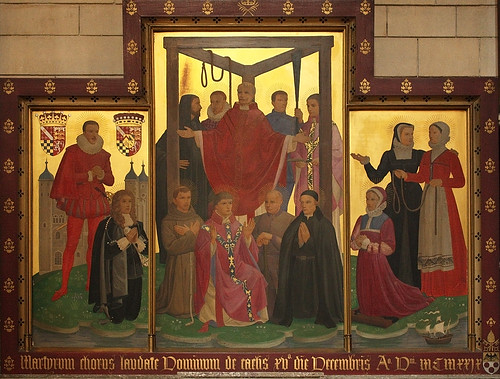
If ever you go to London, make it a point to visit the Tower of London. There at the Salt and Martin Tower of the complex, you need to take a closer look at some of the graffiti and you find scratched on the wall, a “Henry Walpole”. Who was he? Well, Henry Walpole was 23 years old that 1st Dec 1581 when he stood watching the execution of a Jesuit priest named Edmund Campion. Henry was born of a Catholic family. As he was caught in the raging whirlpool of religious confusion, he found indecision as to which religious affiliation he should embrace. At Tyburn, as Edmund was hung, drawn and as his body was quartered, a splash of blood from his entrails landed on the coat of Henry Walpole. It was enough to confirm Henry’s vocation to follow in the footsteps of Edmund. Indeed, the blood of martyr is the seed of the faith.

We begin the Triduum of launching our Jubilee Year with a Jesuit saint. It would be nice if we could begin with St Francis but perhaps it is better to start with a martyr as it would allow us to size up the Jubilee proper that we are coming into.

How is the celebration of a Jesuit martyr relevant to a better perspective of the Jubilee? One of the features of the Jubilee consists of fallowing—letting the fields rest. Thus, in its original form, a year of fallowing was a year of allowing life to catch up. Thus, question to ask is how a martyr’s death is relevant to this fallowing?

That St Edmund died a painful death is not disputed. The details surrounding his conversion and later torture leading to his death have already been preached before. However, the death he shared with the other martyrs recalls us to our founding inspiration as Church. The Church was born of persecution, beginning first with her Lord and Master.

In the apostolic Church, a martyr meant a witness who at any time might be called upon to deny what he testified to, under the penalty of death. The career of the Apostles, with the exception of John the Evangelist took this path. And for the next two hundred years since the birth of the Church, martyrdom was the highest form of witnessing. It was only after the 2nd century that the term confessors was used to denote those who professed their faith, even in times of persecution, but they never reached the point of shedding their blood. With Christianity gaining official recognition, official persecution ended reducing the spectre of martyrdom to a distant memory.

In a sense, confessor-ship emerged whenever the Church entered a period of peace. If this period of peace is not analogous to fallowing, at least it does give the idea that confessor-ship is the primary expression of our testimony. But, think of the monastic flight of the early Church. As soon as Constantine made Christianity the official religion of his empire, the instincts of Christians was to flee. They fled from such an unqualified accommodation with the world; an accommodation they felt had blunted their witnessing.

The first reading speaks of the Suffering Servant in reference both to Christ and to St Edmund. This image of the Suffering Servant can also be extended to the Church—she too is a suffering servant. And whilst the Gospel may warn us of not accommodating the world, in actual fact, we have lost our witnessing edge. We shun away from persecution. We have opted for “Christianity Lite”.

This fear of persecution is compounded by a certain false philosophy brought about by the age of the Enlightenment. We are led into a form of rationality which is deterministic. What do I mean by a rationality which is deterministic. Let me give a good example. “You should know better”. The truth is, just because you are clever is not a guarantee that you will do the right thing. Intelligence often has nothing to do with moral behaviour. [1]

In the expression of our faith, we have come to expect that behaviour should commensurate with rationality. For example, we expect the government to uphold the rights of minorities enshrined in the Constitution for that would be a rational act. As a result, in our various encounters with intransigent or pigheaded behaviour of officialdom, we come away with a sense that we have been done to; that we have been victimised. The fact is, the forces of evil will never stop railing against the Church and persecution will exist as long as the Church of Christ stands. St Edmund did not return to England expecting anything less. He expected no less than bearing the full brunt of persecution. We should expect no less.

Somehow, there is a “pyramidal” system which we cannot get away from. The conciliar document Sacrasanctum concilium speaks of the Eucharist as the source and summit of the life and mission of the Church. What does that mean? It means that the Eucharist is linked to all the other sacraments we celebrate. It is also supported by the liturgy we celebrate. Furthermore, the Eucharist is connected even to the medal or the scapula that one wears. It is linked to the sign of the Cross one makes. I am not speaking of scrupulosity nor am I referring to superstitious practices. But, what happens when we neglect the other sacraments and we do away with devotional practices because we view them as merely “external” rituals? When we neglect the other sacraments, relativise the sacramentals and downplay our liturgical actions, very soon the Eucharist will become meaningless. It will become very much an empty ritual and thus appropriately celebrated as a meal.

The same pyramidal system may be said of “martyrdom”. It is the supreme act of love for Christ to lay down one’s life. The truth is red martyrdom is inextricably linked to white martyrdom. Remember the “daily offering”? O Jesus, through the Immaculate Heart of Mary, I offer you my prayers, works, joys, and sufferings of this day in union with the holy sacrifice of the Mass throughout the world. I am not referring to rushing in blindly to be massacred but really daring to stand up for our faith. It requires that we put up and bear with real sufferings daily. Otherwise red martyrdom remains an ideal. Perhaps you understand why this church is not air-conditioned; a trend that is taken up by many parishes. There may be legitimate reasons for doing so but here there is a greater didactical reason for not doing so. The heat reminds us that we bear our discomfort in the hope that when bigger suffering should visit us, we may be found ready.

So, what relevance is St Edmund Campion to our Jubilee? Expectations are natural for a year to sail smoothly. But, St Edmund’s death shows us that our basic attitude should be a readiness to suffer for our faith, to stand up where it counts and even to die if we have to. If fallowing should mean anything, it is also a time for preparation, a time to ready ourselves for living our faith. Otherwise, the Jubilee is nothing but a celebration of ourselves, a sort of feel-good “pat on the back” but not a witness of the faith sealed and testified by blood and sacrifice.
FOOTNOTE:
[1] This explains so much of our unnecessary anger and frustration. We foolishly expect people to behave according to what they know.

Sunday, 3 October 2010

27th Sunday in Ordinary Time Year C

Funerals are amongst the hatch, match and dispatch functions of a priest. Some funerals are routine—ripe old age, expected time-to-go deaths. Some are difficult—tragic and unexpected death. A funeral not easy to conduct is when a child predeceases his or her parents. Even if a parent were already 85 years old, still the 65-year-old offspring would be the “son” or the “daughter”. No parent ever wants to live longer than his or her children. They say that time heals all pains but for a parent who has lost a child, the pain is particularly piercing.

I started this homily by describing an experience which may help us empathise with Habakkuk, the prophet of the first reading who felt deserted by God. Many who have had to experience unexpected and tragic deaths, felt forsaken by God. They are often muted by God’s silence and their faith is badly shaken.

In the light of God’s promise to fulfil Habakkuk’s trust in Him, perhaps we can speak more about the faith God is also inviting us to. Firstly, we already know more or less the content of our faith because St Paul, in the second reading, encourages Timothy to be faithful to his ministry and to witnessing to Christ. Secondly, we know that the result can only be astounding as the Gospel reminds us that great wonders can be achieved with just a little faith.

But, for many of us, when we speak of faith, we buy into a myth that we may not even be aware of. Let me clarify, by myth, I am not referring to the content of our faith. It means what St Paul affirmed in the second reading about Jesus Christ, the Son of God, as Saviour of the world is not a myth. By myth, I mean rather our approach to the content of our faith. For many faith is believing the believable. This is a reasonable statement in the sense that we believe in what can be believed. "Seeing is believing" is a form of believing in what can be believed.

But, faith is not just content, that is, what to believe in. It is also whom we believe in and how we believe. Our approach to faith, what we understand by having faith, actually describes our relationship with God. In fact, having faith is a description of the quality of that relationship, which is the “how” of faith. Often, with God, we delineate the “how” of faith as we define the parameters and set the rules for engagement. In short, we want to control the environment. What is a controlled environment if not a laboratory? In a controlled environment, something is believable only if it can be tested empirically. However, as long as we move within a controlled environment, what is faith but proofs—proofs that God has answered our prayers. The “how” of our relationship reduces God to one who exists only to grant our desires. In that case, faith still falls within the realm of science and our need for control.

Let me share with you on what struck me most in our recent experience. When we embark on a pilgrimage, we pretty much enter an environment beyond our control. The fact was, we did arrive safely at our destination and we did thank God that He had answered our prayers etc.

But, what about not arriving at our destination safely? If the weather or natural calamities had delayed our journey in such a way that we were stranded in transit or along the way, the coach met with an accident and some of us were injured and some even died?

Like Habakkuk, the first question would be, “Where were you God”? and second, “We set out on this pilgrimage of trust, and yet you have abandoned us”? As long as the result does not fall within our controlled expectations, then the usual interpretation is that God has abandoned us.

GK Chesterton mentioned something about faith and in a piece he wrote on the difference between Christianity and paganism and it makes sense in the context of the Gospel. He says, “Charity means pardoning what is unpardonable, or it is no virtue at all. Hope means hoping when things are hopeless, or it is no virtue at all. And faith means believing the incredible, or it is no virtue at all”.

The quality of our relationship with God must accord with what the Gospel says at the end: “We are merely servants”. It means that in our relationship with God, we must restore God’s sovereign freedom to its rightful place. Faith as believing the incredible is believing in God even when He seems to be silent.

We have established that faith has a content—"what to believe", and a subject—"whom to believe in", God. Our struggle or challenge often is how to believe against all evidence that He is not present.

At Altöting, the Chapel dedicated to Our Lady, we found many votives. A votive could be anything—candles, stitches, paintings, photos, poem and amongst them was one which may help us understand how faith should be lived. Someone wrote to Our Lady: Thank you for not answering my prayers for 18 years. The person must have placed much faith in Our Lady to act according to her desires but only to encounter the sovereignty of Our Lady’s intercession. In the 19th year, her prayers must have been answered in a way more suitable for her than if, through the intercession of Our Lady, the Lord had granted it the minute it was made. Sometimes our request cannot be answered for reasons only known to God.

Today’s Gospel is an invitation to many of us who have found life to be unbearable because God seemed to have abandoned us or God seemed to be silent. Faith is trust, not certainty. Our restoration of God’s sovereign freedom to Him will enable Him to forge for us a solution beyond our expectation.

In conclusion, sometimes people say that, in response to the tragedy they have encountered, they have lost faith, as if they have lost their house keys or their wallets. The truth is, we can never lose our faith, we may be struggling to allow faith to shape our lives according to God’s sovereign desire. In the light of the apostles asking the Lord to increase their faith, we ask that He will grant us the grace on how to allow our lives to be more and more shaped by our trust in Him.

Sunday, 29 August 2010

22nd Sunday in Ordinary Time Year C

Have you heard this alternative story about four people who went to see the Wizard of Oz to ask for gifts and these four were not Dorothy, Scarecrow, Tinman and Lion. One asked for valour, the second for courage, the third for patience and finally the last for humility. Guess who went away looking like the Ugly Duckling?

It is a joke but never mind if you did not get it because it was just an illustration of the theme of this Sunday’s readings. In general, they point in the direction of humility. The first reading praises the person who is humble, a person who is conscious of who he really is. This person will find favour with God. It ties in with the Gospel where the key phrase is “Everyone who exalts himself will be humbled, and the man who humbles himself will be exalted”.

However, in a world where cosmetics is champion, humility is certainly a virtue that is best forgotten or ignored like the Ugly Duckling. And yet, it was humility that saved the world. Christ humbled Himself, becoming obedient unto death, even death on the Cross. The second reading does not exactly put it in that way but it certainly gives the impression that the gathering of the New Jerusalem is around the Mediator of the New Covenant. Who is He but the one who is humble, whom God has exalted and given a name which is above every name and at whose name, all creation must bend.

If humility saves the world and yet we are caught in a world which views humility as the Ugly Duckling, how can we better appreciate the humility necessary for the salvation of our souls?

St Ignatius speaks of humility as three modes of being. The first mode of humility is characterised by lowering myself in as much as I can, so that I will be obedient to God’s law. In this mode of humility, I will not commit mortal sin. This basically characterises many of us. We try to live decent lives and not commit mortal sins. The second mode of humility is better than the first as it consists of a “detached” disposition. In as much as God can be glorified and my salvation can be assured, I choose neither poverty nor riches, neither honour nor dishonour, neither long life nor short life. The analogy here is the equilibrium of a see-saw. And here, I would not commit a venial sin. It is the nature of holiness that when we embark upon the path of holiness, not only do we try to refrain from mortal sins, we also try to conquer venial sins It is an ascetical ascent as we dispose ourselves to God’s grace. But, for many of us, the difficulty might be in the commission of venial sins. We are too attached to them to let go. For example, gossip is a sin too delicious to let go of. Finally, the third mode of humility consists of this: All things being equal, for the greater glory of God and for the salvation of my soul, I desire and choose to be with Christ poor rather than wealth, contempt with Christ laden with it rather than honours. Even further, I desire to be regarded as a useless tool for Christ, who before me was regarded as such, rather than a wise and prudent person in this world. This is close identification as I choose to follow Christ on the royal road to Calvary.

Now, not only do we live in a world where cosmetics is champion, we also live in a world where competition is champion. For example, those of us who give the “middle finger” at a car that cuts into our lane, we may view it as a venial sin which we no longer think twice of committing. But, a closer inspection will reveal that it is not so much a venial sin as it represents an insatiable need to win. Tell me you have never purposely inched your way closer to the car in front of you so that the car in the emergency lane cannot cut into yours? Of course, you reason that the manners of Malaysian drivers leave much to be desired and that is why you will not allow the person in but still, the real rationale is because we do not want to be a loser—the one who has no guts to challenge the other driver. Humility = weakness.

The truth is, it is not a mark of humility to let the other person through. It is not a mark of humility that sends the message out: step all over me. What is humility is perhaps the curbing of our desire to win all the time. And it cuts across every facet of our lives and not just our driving etiquette. In arguments, I do not need to have the last word. Let me give an example. By telling you this story, I think I am going to “sin”. At our recent pilgrimage in Lourdes, I had a fall in the toilet. According to an email sent to me, I fell because I was pissed drunk. I attempted to reply to the email but it back-fired. Finally, I just left it at that. Why? I did not have to justify myself and more importantly, there was no need to win the argument. Now why have I “sinned”? I am well aware that even by this little revelation I have “attempted to justify myself”. I seemed to have the last word! The point is, between friends, siblings and spouses—this is often the scenario—the need to justify or have the last word.

This is where we need to differentiate between “neurosis” and “kenosis”. Humility is self-emptying—kenosis—like Christ who emptied Himself of His divinity. But, some of us may mistake “neurosis” to be “kenosis”. What is neurosis? Let me give a working definition. Let us say we have a student who is a masochist and a teacher who is a sadist. At the end of the year, the teacher decides not to set an exam. Everyone cheers except this one student, the masochist. Humility and suffering are companions and the point is that not all suffering endured is humility. It could just be a neurosis; much like the masochistic student who loved to be "punished" with exams.

A holy priest in Manila used to remark that those who seek humility may be sinful. His explanation was that in order for us to feel humble, somebody has to sin. There is truth in what he said. Neurosis is a false sense of humility and there is a thin line between neurosis and kenosis. Here, the Ignatian principle might help. “All things being equal” meaning that if it does not involve sin, then we choose to stand with Christ humiliated. This is where true kenosis is. A suitable interpretation to explain this is when a situation is really beyond our control, it is when we begin to exercise humility. Humiliation is not something we actively search for but whenever we choose to follow Christ, be assured that there will be humiliation.

Finally, humility as a virtue needs to be supported by the Resurrection. Perhaps, humility’s struggle to be accepted as a viable virtue is but a reflexion of our struggle in believing the Resurrection. In a world where competition has gone wrong, humility is crowded out because we believe that the last and final word must be uttered in this world. But we are assured by the Gospel. “When you have a party, invite the poor, the crippled, the lame, the blind; that they cannot pay you back means that you are fortunate, because repayment will be made to you when the virtuous rise again. The final word does not need be uttered in this world because the Resurrection gives us the assurance that our faith will be vindicated. Thus, to be truly humble, you need to hold to the truth of the Resurrection.

Sunday, 8 August 2010

19th Sunday in Ordinary Time Year C

This evening we have the Rite of Acceptance. The readings are pertinent to what we do. The first reading describes a future unknown—the after-life—which we should not be afraid of. The second reading speaks of how we are to conceive of the after-life—in terms of faith and hope. We are to live in faith and hope as we long for the after-life. Turning to the Gospel, we find the same focus on the after-life but this time, with a twist. Instead of the servant springing into action, it would be the master who serves the servant.

How are the readings relevant to the Rite of Acceptance?

First, the spotlight shines clearly on a topic many of us are uncomfortable or unfamiliar with—the after-life. This after-life is a reality that catches many unawares. We never know how close we are to death and different people respond differently. In general, there is a universal fear of death. For some cultures, it is a taboo subject and so, the first reading addresses this fear on the basis of historical experience. “That night had been foretold to our ancestors, so that, once they saw what kind of oaths they had put their trust in, they would joyfully take courage”. Trust has a historical basis as we see God’s faithfulness to Israel during the Exodus. But, because we cannot fathom what the after-life holds, the second reading encourages faith and especially holds up to us, the figure of Abraham, our father in faith. He left the very place he had called home for an unknown land promised to him and his descendants. According to the author of the Hebrews: Faith is the assurance of things hope for, the conviction of things not seen. However, nowhere does trust and faith encourage complacency—the complacency we are warned against in the Gospel. Instead faith leads to vigilance and the Gospel ends positively by describing the vigilance of the servant who is rewarded with the unthinkable. It the end, it is the Lord who becomes the servant.

We have two possibilities before us. The first possibility belongs to our faculty of choosing. We can choose not to fear and put our trust in the God who never fails. Thus, be vigilant because the reward is beyond expectations. Or second, and this is not always a matter of choice. Many are most “stuck” because of the “unpredictability” of death. Death is almost like a veil of darkness beyond which we peer.

Our response to the unpredictability of life often takes us along the path of a planner. In order to navigate the unknown we plan for any eventualities. We would want to make sure that every variable is under our control. For example, we are encouraged to engage a financial planner as we plan our financial future.

But, our response should not be just the mode of a planner. We must keep before us that no matter how much we plan, life has a way of behaving independent of our planning. When things do not turn out the way we have mapped out, planners usually develop cynicism. Cynicism is often a response to repeated failed attempts at corralling or controlling life.

A pilgrim, on the other hand, is one who accepts life as it unfolds. When I was studying in Dublin, I remember my complaints were always met by my Jesuit brother who used to remind me that “it could be worse”. A planner like me got really annoyed with such a view of life that seemed rather fatalistic bordering on apathetic. But, as I struggled to shape my life according to my schemes and schedules, I began to realise that he had not been wrong. Neither had he been fatalistic. Instead, he had a better pulse of life. Life’s failures and disappointments were the final statements in life but they were real occasions for spiritual growth. A pilgrim dares to accept life as it unfolds because he knows that there is a planner who is larger than the life we know.

This Sunday, the pilgrim invites the planner into a life of faith. Like Abraham who uprooted himself for a new country to stay. The only compass a pilgrim has is his faith in God. However, faith is not foolhardiness in the sense that it is an “either or” option—that one is either a planner or a pilgrim. In fact, we are both. We plan, in as much as we are a logical and a rational people. Organising life is part of what makes us human. And yet, we must never forget that we are pilgrims—people on a journey—recognising that this is not our homeland forever.

The rite of acceptance we celebrate invites this group of people to embrace a life which makes them pilgrims on a journey towards life eternal. The only price the pilgrims pay is faith and vigilance to the Lord’s call. The fulfilment of God’s promise is always beyond our expectation. At the end of this pilgrimage, the vigilant will be rewarded by the Lord who will come to serve him Himself. That is a promise we can stand on.

Monday, 12 April 2010

2nd Sunday of Easter Year C

Pentecost is familiarly described in the Acts of the Apostles. Today’s Gospel taken from John gives us another version of Pentecost. Christ, risen and triumphant, appeared to the Apostles showing them His wounds, giving them His peace, breathing upon them His Spirit and sending them on His mission to preach repentance and the forgiveness of sins.

The sentence is mouthful, but, it really describes the beginning of the Church. And, guess what is also startlingly revealing? There, right at the inception of the Church, we encounter doubt.

When we speak of doubt, we often associate it with the lack of faith. But, doubt and faith are not mutually exclusive. For example: often the unspoken statement for “I don’t believe in God” is “I believe in something else, namely, the canon of science”. In a sense, doubt might be considered a form of belief; just not a belief in God. And, in terms of faith, doubt may be a prelude to belief as in the case of Thomas, doubt was his faith searching for foundation. Fortunately or unfortunately, the foundation which we know most and are comfortable with is science. The difficulty is that faith has a reason or foundation that is far deeper than science and this explains why faith and science are often thought of as incompatible.

Today we shall try to reconcile faith and doubt because Divine Mercy Sunday can help us address the doubt of Thomas.

First, shall we accept that the greatest threat to “belief” is not science, given that one has a deeper foundation than the other? Instead, the threat to faith comes from doubt of a certain kind and this form of doubt is related to science. How is that so? Science has afforded us greater control than ever before, over ourselves through medicine or psychology [1], and over nature through technologies or applied sciences. This self-actualisation, as a consequence of controlling or dominating our inner and physical world, has lulled us into a false sense of invincibility. [2] Furthermore, science gives the illusion that its propositions or claims can be proven systematically whereas the claims of religion cannot be proven and therefore must be relegated to the realm of private experience. The conclusion is, science is logical, and more dependable, whereas religion is not always so. Is it not true that much blood has been shed because of religion? And now, the Catholic priesthood is in the limelight for the wrong reason. As such, we are left with doubts that religion can adequately answer mankind’s search for meaning. In the absence of “wholeness” or “integrity”, dependable and logical science poses organised religion this challenging question: [3] If God is good, how can He allow bad things to happen? This doubt of a certain kind comes from our experiences and there are so many bad experiences. [4]

Perhaps, the doubt that many people have is not so much with the existence of God. Instead, their doubt resides at the level of logical contradiction. Our problem is not with God. Rather, our problem today is with what God purports to do or what God does not do. And often, the behaviour of religious people do not help.

Therefore, the Gospel is apt for the celebration of Divine Mercy as well as to confront doubt. Do you know why Christ, after He greeted the Apostles with peace, showed them His hands and His side? A clean or stylised crucifix does not tell the whole story. In fact, a sanitised cross may belong to a jaded memory. This may explain why Christ kept the marks of His wounds on His risen body. You would think that a risen body should be “perfect”. On the contrary, the wounds were necessary to help the Apostles remember or recognise Him.

Hence, if doubt is not really about the existence of God, you can say that doubt begins with forgetfulness. History tells us that the Church began to use the crucifix as a Christian symbol a few centuries later and not during the apostolic era. Maybe, just maybe, she began to turn to the crucifix because she was beginning to forget what the Lord and Saviour had done for her. When we sanitise our symbols, that is, our sacraments, and our liturgy, we begin to forget. Now, you may understand why some parents do not want to clean the room of their child who has been taken away in an untimely manner. They leave the room as it was because it helps them to remember better the departed child.

Doubt arises when we fail to remember or when we cannot remember. Is that not the case that in a relationship, after a period of inaction, we begin to ask, “Is it true”? When a relationship falls into disuse, we doubt the friendship. But, the doubt does not betray a lack of belief but is rather a symptom of a failing memory. Thus, the command by Christ that we have faithfully carried out for the last two thousand years is “Do this in memory of me”. We celebrate the Eucharist so that we can remember. In fact, as Pope Leo the Great said: What was visible in Christ has now passed into the Sacraments [5] and in the Gospel today, there were at least 2 Sacraments—Confirmation and Confession. Every sacrament is a memory of what Christ has done for us. This is why the use of matter—the outward sign or the ritual—for the celebration of the sacrament has to be generous. That was one of the reasons why we made the Elect enter the pool to douse them amply with the waters of baptism so that they can remember better their being washed clean of sins. Likewise, in the context of the copious use of “water, oil, incense, wine” etc, you begin to appreciate why “dressing up” is important. When a person goes for a date, the place is carefully chosen, make-up applied, expensive perfume is used, the appropriate dress is selected, Miu Miu handbag must match the Prada shoes. Why? It is in order that the date can be memorable. You prepare before an occasion so that you can remember long after the occasion has passed. Now you know why I take the trouble to make sure that the blessings with Holy Water cover everyone. Careful attention to our rituals is an aid to the remembrance of what God has done for us.

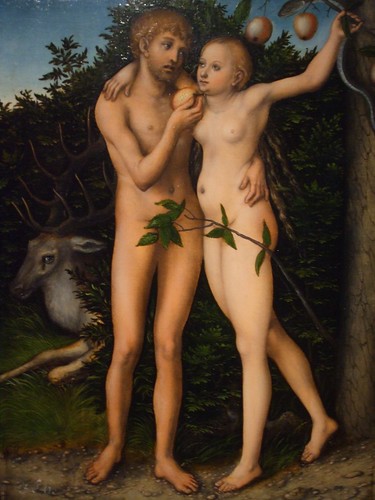
Our struggle is always with remembering [6]. Sin is a result of forgetfulness. Adam’s sin was not because He ate the apple but because He forgot God’s injunction to him. The Israelites were punished in the desert not because they murmured but because they forgot God’s goodness to them. They lost faith when they forgot God. [7]

Today, for Mercy Sunday, even though Christ has risen and is victorious, He comes to us with His wounded body to tell us: “Look at my hands and my side and remember that for you I have died. Doubt no longer”.


FOOTNOTES:

[1] Just check out the familiar soundtrack from a screaming chorus of “self-help” literature which is premised on a “build-your-own-reality” philosophy of life.
[2] In fact, the whole science of “youthfulness” is premised on the invincibility of the physical world. Our craving for youthfulness is emblematic of this quixotic mission to stave off death—to control our physical world.
[3] One of the things we all struggle with is “illogicality”. Science is logical. This is why computer works because they are programmed to do what is asked of them. They follow a certain logic that what goes in must come out. With Man what we encounter is often the perplexing behaviour of Man. We know something is wrong and yet we often do not follow our moral compass. The contrary is true. We know something to be morally wrong and yet do it.
[4] Actually science is not entirely free of the “illogicality” of emotion. In other words, science is not always “objective. For example, the reason scientists chose to study certain questions may come not from “logic” but rather “emotion”.
[5]Sermo 74, 2: PL 54,358
[6] For parents dealing with a child who is naughty and a child who is ungrateful (read = one who has forgotten), the “pain” inflicted seems to be more acute when coming from an ungrateful child.
[7]Faith does not guarantee that we will not be hurt. In fact, faith sometimes makes us feel even more acutely the pains of suffering—just like Christ did. However, what faith guarantees is that nothing, not even death can be the last word in the world; the resurrection of Christ is.

Saturday, 3 April 2010

Easter Vigil Year C

I wish tonight could go on forever. You heard me right. A service of 2 or even 3 hours is just too short. But, the reality is that, like all Catholic services, one always keeps an eye on the clock. It is almost barmy to wish for a long service because people will grow restless. Perhaps “restlessness” is the key to understanding why tonight should be a long service. We celebrate the most solemn of Christian feasts. The larger than usual crowd is testimony that we instinctively know this to be so—that this is a solemnity like no other solemnity and that we have to be here somehow. Why?

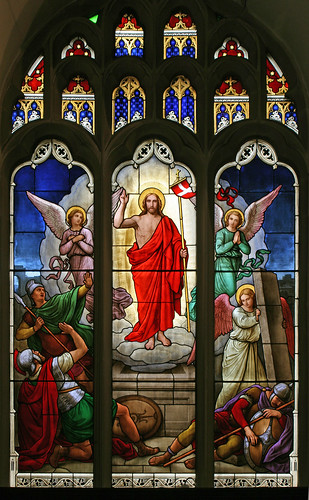
The reason is a celebration that is out of this world—the resurrection. The gathering of the Elect is tied to the hope of the resurrection. In the Letter of St Paul to the Romans, we discern the strong connexion between baptism and the resurrection. “When we were baptised in Christ Jesus we were baptised in His death; in other words, when we were baptised we went into the tomb with Him and joined Him in death, so that as Christ was raised from the dead by the Father’s glory, we too might live a new life”. The basis for baptism is so that we can enjoy the resurrection.

The central proclamation of the Church is the hope of the resurrection. In the Acts of the Apostles, truly a class act, Peter’s preaching or kerygma forms the basis of the apostolic teaching that has come down to us—a kerygma that witnessed to the life, death and resurrection of Christ.

So, how can we appreciate the resurrection 2000 years later? Imagine the 3000-strong Pentecost crowd and as the Acts says, “they were cut to their hearts”. But that is not the end of the story because they asked Peter and the apostles what they must do; just like the Elect asking for baptism. I can imagine how it must have felt like to be there to hear the Apostles’ testimony of their experience of the resurrection of the Lord. The Apostles ate, joked, talked, walked, roughed it out in the open, and finally, after the resurrection, they touched the wounds on His hands and side.

In a sense, they were truly a privileged lot. Would it not be nice to be where they were? It would make what we have here pale in comparison. One almost wishes to be where they were and surely faith would be much easier.

But, is that true? This is plain wishful thinking, just like what we often hear people say: Seeing is believing; seeing makes believing easier. If only we were there, would not faith be easier? In a sense, it might be but being there is no guarantee of faith. If Jesus were to appear today, many of us would have difficulty believing Him to be He. Why? You see, in the matter of belief, probably there are broadly two categories of people. First, the gullible people we read about in the newspapers. For example, the people who believe that paper can turn into US dollars… Gullibility cannot be equated with belief. Believing everything is not necessarily faith. [And the gullibility level of our country has gone up because our education system has gone to hell].

If we are not gullible, then we belong to the second category of people. We believe that Christ will come again but if He were standing here telling us that He is really the Messiah, we would have difficulty believing Him. All you need is someone in the congregation who tells you, “I am the Son of God” and immediately your “cuckoo counter” will start blinking. So, in a sense it must have been harder for Peter and the Apostles. In fact, John 6 is best proof of that. If you want to be where Peter was, preaching to the 3000, you would have to be at John 6 because it had taken a lot for Peter and the Apostles to stay put and not slowly disappear like most of everyone.

So, in the matter of faith, seeing is not always a matter of believing. Instead, faith is an act we have to make, a bridge which only we can cross ourselves. Thus, the Elect tonight should know that for Peter and the Apostles, seeing Jesus was basically that. They know Jesus, they may have many first-hand experiences of Jesus but in the matter of faith, they too had to struggle to come to believe in Him.

Earlier on, I mentioned something about restlessness. We are restless not because the service is long. We are restless because we struggle with the resurrection. We are restless because we fear to live the resurrection. [1]

You see, the best time to celebrate the resurrection is during funerals. Almost every one of us, like Peter and the early Christians, struggles with the resurrection. The two disciples left Jerusalem for Emmaus because they felt let down. Many of us believe in the resurrection but when death assails a person we love, we behave as if this were the only life there is and there is no resurrection. Faith in the resurrection is a vision that can peer beyond the veil of death to see a life awaiting us beyond the here and now.

So, in the end, perhaps “seeing is believing" becomes true when we are able to bear fruit by the way we live our lives. It is when we live our belief in the resurrection that people will be drawn to follow us. The early Christians came to believe Peter and the Apostles because they sense the apostolic faith; believing must bear fruit for others. For so many of us, we need to bear the fruit of our belief so that others can see and sense that we are alive because of the resurrection.

Today we are baptising a small number of people. What a feeble number! Indeed, it is a testimony that our faith is not scintillating enough to draw people to Christ. The resurrection has given us meaning for the next life. But, it has also given us so much more to think about, about how we can make others come to believe in Christ and His resurrection. Elect soon to become Neophytes and all the baptised, we all have our duty all cut out!!

FOOTNOTE:
[1] If the resurrection is of another world, would we not want to be at any of the celebrations that allow us to catch a glimpse of the other world? A good indication of our fear of the resurrection is when we try to solve every problem we have in the world. A world fearful that the resurrection may not be true is one which will seek “certainty” in this world. Of course, younger people are more susceptible to this because they have been fed on the milk that brute strength itself is enough to shape the solution that we are seeking for. Those who live on the edge of life’s winter will perhaps have a more benign view that life is too short to be perfect and that perfection can only be found after the resurrection, as according to St Paul’s Letter to the Philippians (3:21) where “He will transfigure these wretched bodies of ours into copies of His glorious body” and so aptly echoed in the Eucharistic Prayer III used for funeral: In baptism, he died with Christ: may he also share His resurrection, when Christ will raise our mortal bodies and make them like His own in glory… See brothers and sisters, because of the resurrection, divorce, death, disaster cannot be the final dissertations in this life…

Monday, 21 December 2009

4th Sunday of Advent Year C

The 4th Sunday continues with the customary message of Advent hope but it is really a Sunday that belongs to Mary as is suggested by the theme: Mary’s Child: The Prince of Peace. His coming which fulfils Micah’s prophecy requires Mary’s cooperation. The birth of Christ is also the motherhood of Mary and so this Sunday we take a closer look at the blessedness of her faith; the impact of belief in the ordinariness of life.

In today’s Gospel, right after the Annunciation where Mary had put her life into God’s hands, we find her responding to the needs of others. As such, it is appropriate that Mary became the first disciple of the promised Saviour who was to come because she believed and acted on her faith.

As we approach Christmas and are taken in by the grandeur associated with it, we might forget that the relationship between belief and action is not always easy. In the case of Mary, she had to set out for the hill country of Judah, a journey by foot that might take some time. Women of her time would never travel alone. But she, believing the angel’s description of her child as holy, may have set out with the certainty that she would be protected by the holy child in her womb.

But, you do not get this in a straight-forward re-telling of the episode. Instead, we might labour under the impression that faith makes everything easy. In truth, faith does not guarantee the absence of hardship. Faith makes it possible for us to overcome hardship. In the case of Mary, she set out alone without a thought of her safety, relying on the protection of her faith. In summary, we see a correlation between faith and action where one must lead to the other. The implication of faith is action but we know that belief does not always flow into action.

The blessedness of Mary’s faith becomes an inspiration for those who are discouraged either by the futility of their faith or failure of their actions. Many of us may be failed idealists at best or plainly cynical at worst. Either way, a failed idealist or a cynic, both are crying out for faith. As such, Mary is so much more relevant as an icon of faith simply because in a “faithless world” or a “failed world”, the complication is when the “individual” is reduced to “nothingness”. No matter what station in life, almost everyone here knows the powerlessness of being small, marginalised and treated indifferently.

Part of our frustration is somewhat of our own making, meaning that we have all come to believe that all we want we can achieve on our own. In many cases, we sell the myth that faith in our dreams rests simply upon sheer strength. We have come to believe in the invincibility of our efforts or endeavours. Our faith is not in God but in our ability.

If our faith is fundamentally our strength, then Mary as the icon of faith does not make sense. A description of her powerlessness and her faith may essentially be reduced to a description of “Deus ex machina”; that moment in story telling which allows for “divine” intervention of an insolvable difficulty. Just like Cinderella’s fairy godmother appearing at a time when she had no other way to go for the ball. This formula is mostly acted out in our “feel good” movies of the “happy-ending” kind.

But, precisely, the faith of Mary is God’s strength. What she does makes sense only because she believes. Her faith seems “ridiculous” only because we have become more disbelieving or we have come to rely on ourselves. The faith of Mary will always stand out sharply as naïve against the backdrop of a technologically-driven self-sufficient scientific culture or mentality. For example, at Copenhagen, as world leaders engage in useless semantics on climate change, the polar ice-caps are melting faster than the curbing of greenhouse gas emission. To speak of faith other than of our capability suggests “inaction” bordering on a dereliction of duty. Closer to our home-front, even as we hope for the Herald’s outcome, we are left with a sinking feeling that we will lose out anyway because we have not “done” enough. You can discern how faith is related to what we do but often our action is not because we have faith. In fact, our action flows not from believing in God but in ourselves. Faith necessarily leads to action. For us, action is taken to be proof of faith and we know that is not necessarily the case.

Mary teaches us that our faith is God’s strength. She beckons us today not to give up hope because God can be relied upon and the only way we can be sure that God can be relied upon is that we, like Mary, say yes to God and like her, we act believing that God will help us because we allow Him to. Christmas is not that God needs to come but we need God to come. Faith is our call to God and faith is the reason for our actions in the world. Mary’s generous faith gave the Father the permission to send the Son into the world. In these next few days, may Mary’s example encourage us to do likewise: be generous in our faith. We will never be confounded and only then will our actions confirm that.

Sunday, 25 October 2009

30th Sunday in Ordinary Time Year B

In Mark’s Gospel, the story about Bartimaeus is more than the story about blindness and the restoration of sight. It is an account of faith because after his sight was restored, Bartimaeus followed Jesus along the road. An important note is that Jericho is not far from Jerusalem, the place of Christ’s suffering. The symbolism cannot be lost because faith has this effect: to know Christ is to follow Him in suffering.

Basically, Mark’s theology is simply that Christ is the one who brings salvation to Israel. Therefore, healings are a sign that Christ’s salvation is already in the world. Consider that in Mark, very few recognise Jesus as the Messiah. So, it is remarkable and ironical that we have a blind man who recognises Jesus by acknowledging Him with the title of the Messiah: Son of David. And the Messiah’s response to Bartimaeus is not “You are healed” but “Go, your faith has saved you”. A closer reading of the Gospel reveals that blindness actually describes a lack of faith and not the lack of vision.

Thus the Gospel invites us to take a second look at how blind we can be in recognising the Lord and how slow we can be in responding to Him. What sort of faith are we to have?

First, faith is a kind of vision. As far as the eyes can see, we call that the horizon. Now, the horizon we have is provided by our vantage point. What happens is that the higher our vantage point is, the further the distance of our horizon will be! Faith is a vantage point because it allows our eyes to peer into a horizon beyond what our eyes can see.

But, the truth is, many of us are limited in our horizon because we cannot see beyond ourselves. Looking at oneself is not a bad proposition. For example, it is said that “feeling good” about oneself allows us to feel good about others. Or, you cannot give to others what you do not have. However, the challenge is not to allow this “looking inward” or introspection BE just about the self—my needs, my wants, my ambitions, my hurts, my dreams and my vision etc. The “self”, important as it may be, can also be a limitation to horizon because it prevents faith from seeing beyond what we are capable of to what God is capable of.

Faith allows a person to see beyond the self to what is possible. Jesus himself saw beyond the fig tree that Nathaniel was under. He saw a Nathaniel destined to do great things. Jesus saw beyond the sycamore tree that Zacchaeus was on top of. He saw a Zacchaeus who would be converted to a vision of just relationship.

Jesus’ “vision”—what he saw—was not entirely the result of positive thinking because He did see unsavoury business taking place in the Temple and He drove them all out. He lamented the hardness of heart in the Pharisees and the Scribes. In the age of positive thinking, what we think of as “faith” may not be more than what it is: positive thinking. The horizon of faith is deeper and wider than just being an eternal optimist.

Faith frees the heart to feel, the mind to think further and the imagination to dream. The vision of faith allows us to peer beyond the veil of superficial or cosmetic appearance. Thus, when faith is shallow, the mind constricts, the heart chills and the imagination dies. When faith is weak we become engrossed or obsessed with what is only the appearance. Reliance on God becomes more tiring when we have no faith.

In summary, do note that Mark does not normally name the character in play. Hence, Bartimaeus is so named because Mark highlights the pivotal role faith must play in our lives. What we have today is “self-confidence”. It does not lead to Christ. Only with faith will we recognise Jesus and more so Him in the widow, the poor and the orphan. Only with faith will we follow Him and serve Him in those who are “set aside” by society. Furthermore, you see how powerful faith is. As a beggar, Bartimaeus depended on his cloak. The cloak acts as a “net” to catch whatever coins that are thrown at him. When Jesus offered Himself to Bartimaeus, he shrugged off his cloak of dependence and followed Jesus. We all depend on the cloak of our self-confidence. We depend on our capability or strength. But, Bartimaeus shows us who we should really depend on.

Faith is the only key to discipleship and salvation. We need faith to recognise Jesus, to know Him and to shrug off any encumbrances that prevent us from following Him. We need to pray for that gift.