Friday, 25 December 2009

Christmas Year C

Today a Saviour is born for us.

What does that mean?

At the Credo, the profession of faith, we bow profoundly at these words: “By the power of the Holy Spirit He was born of the Virgin and became Man”. The operative word is a profound bow and not a head bow. There are four Masses altogether with different sets of readings between yesterday evening and today. But, what unites these four Masses is, instead of a profound bow, we kneel at the same words.

What does that mean? What implication does this action of kneeling have or why do we have to kneel?

To appreciate why we kneel, we need to look at the way we celebrate Christmas. First of all, Christmas celebrates the fact that Christ came amongst us. According to the lofty Gospel of John, which we will use for the Mass during the Day, that is, this Mass, it says simply: “The Word was made flesh”. This means at Christmas, we celebrate facticity; a fact.

However, facticity does not make sense to some of us. “So what?” one may ask. But, this is not surprising considering that our approach to reality or facticity is via meaning. Thus, the usual take on Christmas is from our perspective. He came, which is a fact, but, more importantly we are concerned about how we can celebrate His coming more meaningfully. A good example of how we can celebrate Christmas more meaningfully can be teased from songs such as “Christmas, isn’t Christmas, till it happens in your heart”. That is not a bad thing simply because we are trying to make Christ known and the only way He is known is through people who call themselves Christians. This may explain why people “denomination hop” or “church hop” because they are discouraged by what they see in a denomination or a church. From our perspective, Christ can only be known when Christians live Christ-like lives. Many homilies are based upon this principle that we are the only Bible that some people will ever read.

Whilst this may be true, the danger of this “human” or “our” perspective is to reduce the facticity of Christ coming to us. That means if we were less Christian, therefore, Christ would be less real.

But, is He? The answer is “no”. Therefore, today we are not concerned by “how” Christian we are to the world, even though that is important.

Whilst we must be concerned about making Christmas more meaningful, that is, more relevant, sometimes, we forget that the facticity or the reality of His coming is so that we can be like Him. Without Him there is no reason for a better world. Changing the world follows from recognising who He is: Emmanuel—God with us.

That is why we bow so profoundly at the creed and later after the homily, we kneel. We celebrate that event which according to St Paul to the Philippians, he says, “that at the name of Jesus every knee shall bow”.

Why the reality of His birth is so important is illustrated in this story which you may have heard before.

“One raw winter night a farmer heard an irregular thumping sound against his kitchen storm door. He went to a window and watched as tiny, shivering sparrows, attracted to the evident warmth inside, beat in vain against the glass. Touched, the farmer bundled up and trudged through fresh snow to open the barn door for the struggling birds. He turned on the lights and tossed some hay in the corner. But the sparrows, which had scattered in all directions when he emerged from the house, hid in the darkness, afraid. The man tried various tactics to get them into the barn. He laid down a trail of Jacob’s biscuit crumbs to direct them. He tried circling behind the birds to drive them to the barn. Nothing worked. He, a huge, alien creature, had terrified them; the birds couldn’t comprehend that he actually desired to help. The farmer withdrew to his house and watched the doomed sparrows through a window. As he stared, a thought hit him like lightning from a clear blue sky: If only I could become a bird – one of them – just for a moment. Then I wouldn’t frighten them so. I could show them the way to warmth and safety.

At the same moment, another thought dawned on him. He grasped the reason Jesus was born”.

Christ has come even though many of us are unchristian but precisely many of us remain unchristian simply because we are not converted to the facticity of His coming. This is why every year, we are reminded of this fact: He took our flesh in order that we may become more divine. Try bowing profoundly and you will know what I mean.

At Babel, Man wanted to approach God on his own merit. So, Man built a tower hoping to touch heaven in order to tell God, “God, here in heaven, I stand at par with You”. The same is observed when people say, “Why go for Confession when I am going to sin again”. It is Babel Volume II in this sense: “Look God, I am imperfect. Let me make myself perfect before I come before You in Confession”. Is that not trying to make oneself at par with God? The profound bow and the bending of knee restore the proper relationship between God and man, that is, we are creatures before the Creator.

The posture of the creature before the Creator is important in our quest for a meaningful and better world of peace, justice and harmony. Our desire for a better world does not begin with a grandiose plan. It begins when we embrace or better still, kneel, acknowledging the reality that Christ was born. The Creator has come. He is with us. He is the reason why everything is possible: we endure suffering more patiently and more perfectly and certainly we love the world better and more generously. The path to a better world begins with our knees. So, fall on your knees, oh hear the angels’ voices... O Night Divine. O Night when Christ was born. O Night Divine. O Night O Night divine.

Monday, 21 December 2009

4th Sunday of Advent Year C

The 4th Sunday continues with the customary message of Advent hope but it is really a Sunday that belongs to Mary as is suggested by the theme: Mary’s Child: The Prince of Peace. His coming which fulfils Micah’s prophecy requires Mary’s cooperation. The birth of Christ is also the motherhood of Mary and so this Sunday we take a closer look at the blessedness of her faith; the impact of belief in the ordinariness of life.

In today’s Gospel, right after the Annunciation where Mary had put her life into God’s hands, we find her responding to the needs of others. As such, it is appropriate that Mary became the first disciple of the promised Saviour who was to come because she believed and acted on her faith.

As we approach Christmas and are taken in by the grandeur associated with it, we might forget that the relationship between belief and action is not always easy. In the case of Mary, she had to set out for the hill country of Judah, a journey by foot that might take some time. Women of her time would never travel alone. But she, believing the angel’s description of her child as holy, may have set out with the certainty that she would be protected by the holy child in her womb.

But, you do not get this in a straight-forward re-telling of the episode. Instead, we might labour under the impression that faith makes everything easy. In truth, faith does not guarantee the absence of hardship. Faith makes it possible for us to overcome hardship. In the case of Mary, she set out alone without a thought of her safety, relying on the protection of her faith. In summary, we see a correlation between faith and action where one must lead to the other. The implication of faith is action but we know that belief does not always flow into action.

The blessedness of Mary’s faith becomes an inspiration for those who are discouraged either by the futility of their faith or failure of their actions. Many of us may be failed idealists at best or plainly cynical at worst. Either way, a failed idealist or a cynic, both are crying out for faith. As such, Mary is so much more relevant as an icon of faith simply because in a “faithless world” or a “failed world”, the complication is when the “individual” is reduced to “nothingness”. No matter what station in life, almost everyone here knows the powerlessness of being small, marginalised and treated indifferently.

Part of our frustration is somewhat of our own making, meaning that we have all come to believe that all we want we can achieve on our own. In many cases, we sell the myth that faith in our dreams rests simply upon sheer strength. We have come to believe in the invincibility of our efforts or endeavours. Our faith is not in God but in our ability.

If our faith is fundamentally our strength, then Mary as the icon of faith does not make sense. A description of her powerlessness and her faith may essentially be reduced to a description of “Deus ex machina”; that moment in story telling which allows for “divine” intervention of an insolvable difficulty. Just like Cinderella’s fairy godmother appearing at a time when she had no other way to go for the ball. This formula is mostly acted out in our “feel good” movies of the “happy-ending” kind.

But, precisely, the faith of Mary is God’s strength. What she does makes sense only because she believes. Her faith seems “ridiculous” only because we have become more disbelieving or we have come to rely on ourselves. The faith of Mary will always stand out sharply as naïve against the backdrop of a technologically-driven self-sufficient scientific culture or mentality. For example, at Copenhagen, as world leaders engage in useless semantics on climate change, the polar ice-caps are melting faster than the curbing of greenhouse gas emission. To speak of faith other than of our capability suggests “inaction” bordering on a dereliction of duty. Closer to our home-front, even as we hope for the Herald’s outcome, we are left with a sinking feeling that we will lose out anyway because we have not “done” enough. You can discern how faith is related to what we do but often our action is not because we have faith. In fact, our action flows not from believing in God but in ourselves. Faith necessarily leads to action. For us, action is taken to be proof of faith and we know that is not necessarily the case.

Mary teaches us that our faith is God’s strength. She beckons us today not to give up hope because God can be relied upon and the only way we can be sure that God can be relied upon is that we, like Mary, say yes to God and like her, we act believing that God will help us because we allow Him to. Christmas is not that God needs to come but we need God to come. Faith is our call to God and faith is the reason for our actions in the world. Mary’s generous faith gave the Father the permission to send the Son into the world. In these next few days, may Mary’s example encourage us to do likewise: be generous in our faith. We will never be confounded and only then will our actions confirm that.

Sunday, 13 December 2009

3rd Sunday of Advent Year C

Today is called Gaudete Sunday for the simple reason that some Sundays take their names from the first line of the Entrance Antiphon, the “Introit”. The entrance antiphon is taken from St Paul’s Letter to the Philippians (4:4) which is the first sentence of the 2nd Reading “Gaudete in Domino semper”, translated as “Rejoice in the Lord always”. The Jerusalem Bible translates it tritely as “Be happy” making it sound like a bit like a Bob Marley song. Some priests even try to avoid celebrating Mass this Sunday or the 4th Sunday of Lent because they do not like to be dressed in “rose”. So, apart from the rose-coloured vestment, what significance can we derive from this celebration?

All the readings share the same theme: the nearness of the Lord. And so, in Prophet Zephaniah, God’s nearness is painted in the royal colour of a faithful God steadfast to His unfaithful and unworthy bride. St Paul, believing that the 2nd Coming is imminent, urges the people to give witness to God’s nearness by letting go of their anxiety and living in a spirit of prayer and thanksgiving. Finally, the theme of the Lord’s nearness is at the centre of John the Baptist’s preaching: Escape the Lord’s judgement by preparing for His coming because judgement is always associated with His coming.

In the context of waiting for the Lord, the knowledge that our salvation is near is the cause of our joy. The three readings tell us that it is so near that we can almost taste it. And this joy in relation to His coming becomes for us a moment of reflexion.

In a nutshell, both Lent and Advent are actually seasons which capture the history of salvation between Christ’s Incarnation and His 2nd Coming. There is not a moment in salvation history that Man is not waiting for Him to come. But, in the context of the long wait, the rose-coloured vestment makes sense, not only because it is sacramental in nature but because it helps relieve the tedium of waiting.

The human spirit, in order to be human, needs rest. The word that appropriately describes this necessary rest is recreation. Here we are brought back to the genesis of creation: paradise. Recreation is recalling that moment before the human spirit was injured by sin. Recreation is the restoration of the human spirit so that refreshed, it can continue along the path of salvation. We are, after all, pilgrims on a journey.

However, we have taken “rest” as necessary for the journey to be the end in itself. Two nights ago, we had to send someone home to Bangsar and the remark about Bangsar was that it was no longer the place “to be seen at” at night. Now, the “to be seen at” places are Sri Hartamas and the Curve. I am not interested which “being seen at” place is the most happening one but instead, I am interested to question the meaning of these places. You see, in terms of rest, there is a similarity between Gaudete Sunday and Sri Hartamas or the Curve. But, that is where the similarity ends. These places represent not so much the search for fun but rather this pre-occupation with “never-ending” fun—where night becomes day, where recreation actually results in tiredness because people have to sleep during the day to regain what they had lost at night. It is not sin but a form of sickness. In short, the journey is not punctuated by rest or the journey is not made lighter by recreation. On the contrary, our preoccupation is basically recreation in itself. Is that any wonder why Christmas is so blasé on the 26th December when the decoration would have lost its glitter? Our life’s mission is condemned to this relentless search for one “high” to another “high”.

On the one hand, this reveals a tiredness in the human spirit. Thus, “fun” or the search for "highs" is our escape from the tedium of life. But on the other hand, the inability to look beyond earthly happiness is indicative of this lack of a vision beyond this world. We are caught up with what this world has to offer forgetting that the offering of this world is only a tease, a foretaste of the real deal that awaits us all. Dim sum is a good phrase to use. Many of us eat sio mai or ha kao with nary a thought but dim sum means “to gently tease the heart”. All food and all good things are meant to tease the heart because fun is eschatological. It points to the end time.

Everything that we have, in the context of journey or pilgrimage, is given as means and not as the end. That is why John the Baptist spoke of sharing the two tunics, exacting no more than the rate required, refraining from extortion and intimidation. Everything we have is dim sum—temporary—given as a respite in this vale of tear—lacrimarum valle. Clinging on to dear life or to everything that we have betrays a lack of trust in the eschaton or the resurrection. Here, I make a digression because earlier I had mentioned about sleep and night. Well, night is a form of death and our acquiescence through sleeping is actually a tacit acceptance of the eschaton or the resurrection.

Coming back to the image of this lacrimarum valle, I like it. Why? Life is hard... or it is supposed to be hard. Let me clarify this. Life is hard but not necessarily that we make it harder. There is a difference between accepting that life is hard and making it hard. So, when life is hard, whatever good that comes, we begin to appreciate it better and it helps us to rethink about the world in such a way that we use whatever good we have to help us and others further our journey. It helps us to put into proper perspective that nothing in this world is to be forever.

Thus, the significance of the rose-coloured vestment is that it breaks the “monotony” of the purple of waiting by introducing joy in an otherwise sad world. Rose is the halfway of the red of martyrdom and also halfway of the purple of penitence. So, by all means, have fun, go to Sri Hartamas or the Curve but remember that the “good times” point to somewhere else, they are simply the dim sum of the eschaton and our life’s mission is to work for that somewhere else. Gaudete Sunday serves to give us a correct perspective of the life to come as we catch a glimpse of the goodness that God can be to us all.

Monday, 7 December 2009

2nd Sunday of Advent Year C

The 1st Reading is deeply sacramental. Look at how the 3 great monotheistic religions that claim common ancestry from Abraham—Judaism, Christianity and Islam—are engaged in the contestation, at times violent, for the patch of plateaux, mountains, hills and valleys called Jerusalem. The Prophet Baruch describes how the Exiled will be brought back to Jerusalem, the city of God; the place where God’s peace can be found. The etymology of its name connotes “completeness, wholeness and soundness”. Jerusalem was to be the radiating heart of the world of completeness and wholeness. Perhaps, you can discern why this constant desire to return to this city explains the sacramental character of the 1st Reading. Jerusalem is the outward sign of God’s presence in the world.

John the Baptist, in the Gospel today, cries out, “Prepare the way for the Lord and make straight His paths”. In light of the sacramental character of the 1st Reading, the place where God’s peace or wholeness is to be found is now translated into a person: the Prince of Peace. Jesus is the person where wholeness is to be located. In short, in Him, all mankind shall see the salvation of God.

In order to see God’s salvation, we must want it or we must need it. The theme this Sunday is the “Joy of Salvation”. In a world which is seemingly perfect because of our capability, it is not easy to discern how we can ever be saved or why we even need it in the first place. Since we function along the principle of efficient self-management, it is hard to comprehend the joy that comes with salvation. Thus, God cannot save if we do not need Him. And if we do not realise that we need God’s salvation, since we are made for God, the simple result is that there will always be emptiness in our hearts.

A way in which the principle of efficient self-management is worked out is a form of spiritual pride. Some of us fail to see it that way but there are times when we believe that God cannot love us because of our imperfections and our sins. You know how often we punish ourselves by thinking such? This is borne out by the reluctance to go for confessions and for good reason. People ask earnestly: “Why go for confessions when I am going to sin again?” [1] Confession, in essence, is the acknowledgement that we need God’s salvation but, for many of us, the basis for confession shows that we do not really need God. How so? For many of us, confession makes sense only if one does not sin or one is incapable of sin. And so the reason goes that “I will only go for confession if I am assured that I will not sin again. But since I cannot assure God that I will not sin again, I shall neither waste my time nor God’s time by going for confessions”. You can see that intention is good but the reasoning is spurious. If that is not spiritual pride, I don’t know what is.

Here, let me be clear that I am not making a pitch for confessions or the necessity of it. I am merely trying to explain why the apprehension concerning confession masks the spiritual pride of a generation that believes salvation is the fruit not of God’s doing but its own machination. We can manufacture our salvation. This does sound like the tagline from The Six Million Dollar Man: Gentlemen, we can rebuild him. We have the technology. Translated: We can rebuild ourselves without God. Does this not remind you of communism? Communism was an attempt to save mankind from itself and it tries to do it without reference to God. But, sadly, a world without God is joyless.

However, salvation brings joy or if you like, the appreciation that salvation is near brings joy. The 2nd Reading radiates the joy of the salvation which Christ brings. If you read further, you will find the context of Paul’s joy is that he writes to the Philippians even though he is in prison. Paul is in prison and yet he can still write. This is how the joy of salvation is brought home to us. For Paul to encourage the Philippians even though he is in prison shows an appreciation that no time is ever out of the scope of salvation. It is an optimism which is founded on no less than the person of Christ. In Him, all mankind shall see the salvation of God. It is the only reason why Paul can exhort the Corinthians (2 Cor 4:8ff): "We are in difficulties on all sides, but never cornered; we see no answer to our problems, but never despair; we have been persecuted, but never deserted; knocked down, but never killed; always, wherever we may be, we carry with us in our body the death of Jesus". The nearness of salvation gives us the sure hope of joy.

We live in troubled times, do we not? As The Star report states on 4th Dec that more than 304,358 people seemed to think so last year as they left the country. The Herald may have won a reprieve in the use of the word Allah but will judges who dare to stand up for judicial independence be subjugated by "routine administrative processes"? Will our need for greater transparency in governance be stymied by vested interest of a few? The depressing and disappointing list goes on.

But, we dare to labour joyfully knowing that it will not be in vain because salvation has not only been promised to us; salvation is much closer than we think. Advent’s wait is a reminder that the joy of salvation is a distinct possibility for those who embrace Christ. Every valley will be filled in, every mountain and hill be laid low, winding ways will be straightened and rough roads made smooth because only in Christ shall mankind come to know the fullness of salvation. Advent is ever pregnant with joy.

FOOTNOTE:
[1] Sometimes the contrary is true. It is not the fact that one will sin again that makes us reluctant to go for confession. Sometimes we feel that our sin is so big that we feel ourselves hopeless. We are in effect saying that God’s mercy is not big enough for our sins; God is not bigger than our sins.

Sunday, 22 November 2009

Christ the King Year B

In a few weeks’ time, we will celebrate Christmas. Personally, Christmas, like Easter, does not excite me. They represent more work! But, apart from that, you may be wondering why both Christmas and Easter do not excite me. In a sense both are “matter of fact” type of celebrations. Christmas celebrates the fact that the 2nd person of the Trinity was born of the Virgin Mary. Easter celebrates the fact that Christ suffered, died and rose in order that we might have life. Christ’s birth, passion, death and resurrection are facts for eternal life. We rejoice at Christmas and Easter because of the salvation brought about by Christ.

Today, I am excited so much so that I told Fr AT to take this weekend off because I can’t seem to get enough of the Last Sunday of the year. Why? Luke 24 provides a glimpse of this excitement. In that chapter we find the post-resurrection experience of the 2 disciples on the Road to Emmaus. After their encounter with Christ one of them said: “Did not our hearts burnt within us as he talked to us on the road and explained the Scripture to us”.

There is a burning in the heart because we are celebrating not just a fact but an ideal of who we can be. I am happy with the fact that we have been saved but I am even more excited by the possibility of who we can be. Christ the King is an invitation as well as the reason for our being here. A part of the preface for the solemnity (that is, the part of the anaphora between the “Introductory Dialogue of the Eucharistic Prayer” and the Acclamation: the Sanctus) shows how it is both an invitation and a reason for our presence here.

You anointed Jesus Christ, your only Son, with the oil of gladness, as the eternal priest and universal king. As priest, he offered His life on the altar of the cross and redeemed the human race by this one perfect sacrifice of peace. As King He claims dominion over all creation, that He may present to you, His almighty Father, an eternal and universal kingdom: a kingdom of truth and life, a kingdom of holiness and grace, a kingdom of justice, love and peace.

Now, together with the fact of Christmas and Easter, the preface presents a majestic sweep of the Christian vision—an ideal that our hearts can burn with. We have, on the one hand, Christmas and Easter proclaiming the fact that Christ has triumphed over Death. No longer can death hold us captives forever. The birth, passion, death and resurrection of Christ assure us that in our contention with Death, His victory will be ours. Eternal life, lost by man’s disobedience, has now been restored by Christ Himself. On the other hand, this grand vision of Christ as King puts into perspective the struggles that we encounter and will continue to encounter. We struggle because creation is groaning; creation is reaching out for the fullness of redemption. The perspective that creation is groaning helps us answer some fundamental questions arising from the experience of evil: the sufferings of illnesses, the destruction of natural calamities and the evils of injustice etc. We often ask the question, why is God so good and yet He allows such suffering? Suffering is part of creation’s groaning and yearning for the fullness of Christ’s salvation. Christ victory puts us back on track towards God and our so-called suffering here on earth is part of that return to God. A helpful analogy is that the war is over but we still have pockets of resistance to clear. We are not called Church Militant for nothing. We are Church Militant because we are engaged in the cleaning up process. In this engagement, we struggle but we know that we will never be defeated as we are engaged in the furthering of the kingdom which Christ has come to establish. The heart aching for His kingdom prompts each and every one of us to engage in or be part of His enterprise not as some faraway project set in the future but as part of the present because the future is in fact now. The future begins now.

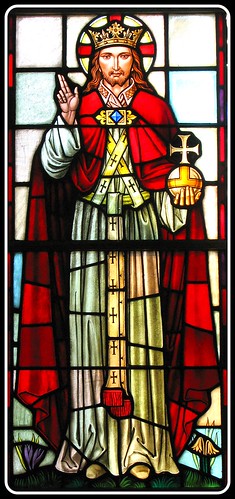
The only way to be converted to this endeavour is through the eyes of love. The Gospel presents us with an image of Christ which makes possible this conversion. He stands powerless before the power of all powers. If you think about it, this image of a powerless Christ runs counter to the rank we ascribe to Him: A King. And yet, this powerless Christ is the very foundation of the Kingdom that He has come to establish. Thankfully, an image presented by St Ignatius may help. He says, “Consider Christ our Lord, standing in a lowly place in a great plain about the region of Jerusalem, His appearance beautiful and attractive. Consider how the Lord of all the world [who is not high and mighty but] chooses so many persons, apostles, disciples etc and sends them throughout the whole world to spread His sacred doctrine among all men, no matter what their state or condition”. This image of St Ignatius is found here in our stained glass. There you will find the majestic King humble in His service. He looks after the lambs and invites us to share in that mission of His.

I can’t tell you how to be excited. All I can say is this: my baptism is meaningless; so too my confirmation. My ordination is useless and so too the Eucharist I am celebrating. All these sacraments I have received are useless unless I am ready and I desire with my heart to be at the service of Christ my King in any way He sees fit for His kingdom. You may say the same for you: Your baptism is meaningless; so too your confirmation. Your marriage is useless and so too the Mass you are attending unless you too offer yourself simply because the very purpose of one’s existence is so that every breath of one’s being is directed to that enterprise of Christ the King that at the end of time, “He claims dominion over all creation, that He may present to His almighty Father, an eternal and universal kingdom: a kingdom of truth and life, a kingdom of holiness and grace, a kingdom of justice, love and peace”.

We all want excitement or we may crave the adrenalin rush. But, that excitement gives us a temporary high. The only “high”, the only genuine “high” worth living for is to be in the service of Christ the King [not adrenalin] because in Him, nothing “bad” is ever definitive—a bad job, a broken relationship, an unjust situation... the list can go on. A young doctor who is in compulsory public service came up to me to say yesterday: “I can see now that no matter how ‘crappy’ my job is, it is still possible to be part of Christ’s Kingdom”... Perhaps you understand why we can be excited because in Christ who is King, everything, no matter how bad, is pregnant with the possibilities of the Kingdom to come. It is possible if you say yes. The answer is with you.

Sunday, 15 November 2009

33rd Sunday in Ordinary Time Year B

Today is the 2nd last Sunday of the liturgical year. There is a feeling that we are neither here nor there because the readings will be some sort of a repeat next week! The 1st Reading and the Gospel are apocalyptic enough as they warn us of the impending end time. Daniel gives a vision of the resurrection and also the reward or the retribution for how we live this life. We know that the end time will come. Just that the Gospel tells that that time is known only to God. Thankfully, we have the 2nd Reading as it ties in very well with the theme: The eternal perfection of all whom Christ is sanctifying.

The 2nd Reading is the occasion for the misunderstanding of some people of what we do here every Sunday. We celebrate the sacrifice of the Mass. But, for some time, especially after Vatican II, we began to call the Mass by any other name except that of a sacrifice. We thought of the Mass as a memorial meal because we were supposed to remember a meal that Jesus had with the disciples before His passion on the Cross. Or, in many cases, it was basically considered a fellowship meal as its function was reduced to helping us build our relationship with one another. But, the Mass is more than just a memory of the past and the occasion for fellowship. It is the perfect sacrifice of Christ offered once and for all. At this point, I would like to make a little digression here. If the Mass were basically a fellowship meal, then both the posture and the music must serve that function. For example: a less solemn and easier going posture and the music light and easy. [One of the Pater nosters that some choirs use sounds like “Puff the Magic Dragon”]. But if the Mass is sacrifice, then the posture, for example, the priest facing the Crucifix, and the music solemn makes more sense. Later, I will say more of why the posture and music is important.

But, for now, let me return to the phrase "offered once and for all" because it raises a fundamental question. There in Hebrews, it clearly says that Christ does not have to offer Himself again and again, like the high priest going into the sanctuary year after year. Thus, if Christ offered Himself as sacrifice on Calvary once and for all, then what are we doing here?

Let us see how we can answer this. First, Calvary and the Last Supper are inseparably linked because they are both the one and the same sacrifice. The Gospel of John gives you a glimpse of that close connexion. When the soldier pierced His side to see if He were dead, according to John’s Gospel, blood and water gushed out. The Church interprets the blood and water to be the fountain of sacramental life, namely the sacraments of Eucharist and baptism. You hear this beautiful description in the Preface for the Solemnity of the Sacred Heart of Jesus.

Second, if we accept that Calvary and the Last Supper were one event, then we begin to understand that there is a difference between "time" and "time". The ancient Greeks make a distinction between two experiences of time. One is chronological in the sense that there is a past, present and future. Our common experience of time is linear which means that an event has a beginning or an ending in time. As such, chronological time is quantitative because you can measure it. However, there is another time which is more qualitative and they call it “kairos” and the quality of this time is an experience of eternity. Why? Because, for God, all time is the same in which the present takes in the past as it projects the future. Even though both the Last Supper and Calvary are chronological events in the past, meaning that they happened some two thousand years ago but they are, in God, events that are still present and so in a sense, they can touch our lives here and now. Therefore, kairos transcends chronos because it is a kind of time in which a reality, even though past, becomes ever-present. This kind of time, kairos, is the basis for us to say that at baptism, we enter into the passion, death and resurrection of Christ, even though chronologically, the passion, death and resurrection of Christ happened more than 2000 years ago.

Hence, kairos is the basis for the “anamnesis” of our Mass. The command, “Do this in memory of me” is not a commemoration of the past in the sense that we are simply recollecting a past event in chronological time. Instead, it is a living memory in the sense that we are calling to mind that there is an event that has the capacity to touch our lives even now. Anamnesis means that we are present in the kairos sense at the Last Supper. The Eucharist we celebrate now is thus a sacrifice because through it, with it and in it, we are perpetually making present the sacrifice of Christ on Calvary. Now I return to the earlier point I made about posture and music. The posture of facing the Crucifix is appropriately sacrificial. We are making ourselves present to Christ being present to us in offering Himself [and we with Him] as sacrifice to the Father.

It is precisely this re-presenting that allows the theme to speak of the Eucharist as the “eternal perfection of all whom Christ is sanctifying”. Only the sacrifice of Christ can take away our sins and make us holy. And this act of Christ is only possible if we can in some way come face to face with THE event that took place chronologically 2000 years ago. The Council of Trent through the Doctrine on the Most Holy Sacrifice of the Mass taught that, “in this divine sacrifice which is celebrated in the mass, that same Christ is contained and immolated in an unbloody manner, who once offered Himself in a bloody manner on the altar of the cross... For the victim is one and the same, the same now offering by the ministry of priests, who then offered Himself on the cross, the manner alone of offering being different”. [22nd Session of Trent. Doctrine on the Sacrifice of the Mass]. Thus, the sacrifice of the Mass is the very action of Christ washing away our sins with His Blood shed on the altar of the Cross.

So, brothers and sisters, we are warned that chronological time is apocalyptic. It can come to an end and the worst possible scenario is painted by Daniel and Christ: to be caught unawares. And yet, kairotic time gives us the assurance that we will never be caught unawares, that is, if we keep before us the true source of our sustenance: Christ Himself who becomes present to us really through the Sacrifice of the Mass that we celebrate every Sunday.

Sunday, 8 November 2009

32nd Sunday in Ordinary Time Year B

To some preachers, the readings are a bonanza because one can develop the theme of generosity and apply it to the congregation. “Give! Give until it hurts! If it does not hurt, then you have not been generous enough”. But, is there more to this “giving till it hurts” generosity for the congregation or parishioners? Yes, and both are found in the two widows of the 1st Reading and the Gospel. There are two lessons to be learnt even though both are centred on one theme: God in whom we trust.

In biblical times, even amongst the poor, there is probably a hierarchy and widows are placed right at the bottom of the social class. In a culture which places a great emphasis on honour, widows often have no one to defend their honour. The word “widow” itself can also mean, in Hebrew, one who is silent.

Thus, we might think that the Gospel is highlighting the generosity of a voiceless widow. It is, but, Christ is not so much praising the widow as He is lamenting how she has become poorer. Her worsened position must be seen in the context of who the Scribes are and what role they play in society. The Scribes are those who know the Law. If widows are at the bottom of the social hierarchy, then the scribes must belong to the upper stratum and this is confirmed by their preoccupation with honour. From their position, they have the authority to teach. That they love themselves too much is not the problem. The problem is Christ points to them as “men who swallow the property of widows”. Why? In giving all she has, the widow has further worsened her situation. Never mind that she trusts God. Her abandonment to God is actually a condemnation of those who have allowed her to be in such a situation. Thus, Christ is lamenting that the Scribes, whose teaching must have included the sacrifice of giving generously, has effectively reduced the woman to such dire straits. What they teach has further increased the depth of the widow’s penury or poverty.

As such, the widow in the Gospel challenges us on two counts. First, you would think that we have come a long and enlightened way. But, when you read of personalities (who have to remain nameless) and their making a show of their "noble largesse", we know that the phenomenon of shameless parading is still alive. In the context of this benevolence, what is worse is that much of the wealth has been ill-gotten in the first place. But, that is not the point. What is more important is to become more aware of how our actions affect the poor. That is the challenge of the Gospel’s widow. By what we do or what we do not do, have the poor become poorer? This is the part where we begin to be more aware of what we do with what we have. Parading our “generosity” is not enough. Nowhere does Christ condemn the wealthy for being wealthy. Wealth may be God’s choicest blessing but for those who do not know how to use it, it becomes a curse.

Thus, the widow in the Gospel teaches us, that apart from generous giving and trust in God, those of us who are more blessed need to be aware of what the true nature of blessing is. The blessing of having more is never for oneself. What we do with what we have is also an act of trust in and a response to God’s providence and this allows us to take a look at the widow of the 1st Reading.

First, consider her “double” silence. She is not just a widow but a “foreign” widow with a child to support. As such, she is doubly disadvantaged. Her encounter with Elijah teaches us that no matter how disadvantaged, one can still be generous. In a way our widow in the 1st Reading is like the widow in the Gospel because objectively by giving everything she has, she has also worsened her situation—"we shall eat and die". But unlike the widow in the Gospel, the situation is made different by her subjective response. We are never impoverished if we begin to share what we have. Thus, the difference between the two widows teaches us that we may be made poor objectively but our response to an objective situation must always be subjective, that is, personal.

Whilst the widow in the Gospel is made poorer by her objective situation, the widow of Elijah by her subjective response has freed herself to receive God’s providence. This is where we are challenged in our giving. There will be a lot of times where we will not be in control. The political landscape shows that injustice abounds in the country. The environment is not cooperating with us as we experience floods in the East Coast. We are told that the economy is improving but a neighbouring country known for its corruption is now even more transparent than we are and drawing foreign direct investment. All these factors may come together to restrict our freedom or narrow the scope of our action, like the widow in the Gospel. But the widow in the 1st Reading illustrates that freedom, no matter how restricted, is never so that we cannot be generous. That generosity comes only when we believe that God will provide. Otherwise we remain always in the territory of giving from our abundance or from our surplus and not from what we need. In short, we give what we do not need. Let me stress that there is nothing to be ashamed of even though many of us are like that. It is a natural response to any situation of lack or want. The parish is like that too. I tell other parish priests not to come to our parish for their fund-raising believing that there is only this much of generosity and we cannot spare. It actually betrays a lack of trust in people and more so in God.

That is why true generosity is a gift of the Holy Spirit for it is a heroic virtue. Any preacher who sets about asking people to give until it hurts may work on the sentiments of people who are shamed into giving—like telling the congregation that the "Proddies" give 10% and by our calculation Catholics on average give less than 1%. But, in the face of God’s Providence, to be shamed into giving would be a slap in the face of God whom we can trust. We give not because we are shamed. We give because God can be trusted for He is the giver of all things good. The 2nd Reading is our confirmation. If God can give His Son who sacrificed Himself to do away with our sins, what would God not give since He has paid the price for our salvation, with no less than the blood of His Son?

Generosity is a companion of freedom. When one gives freely, the result can only be freedom on our part—a freedom that no wealth or money could ever buy. The path to this freedom is to desire this faith and generosity to trust in God. We pray for that freedom to be generous.